Views: 0 Author: Site Editor Publish Time: 2026-10-20 Origin: Site
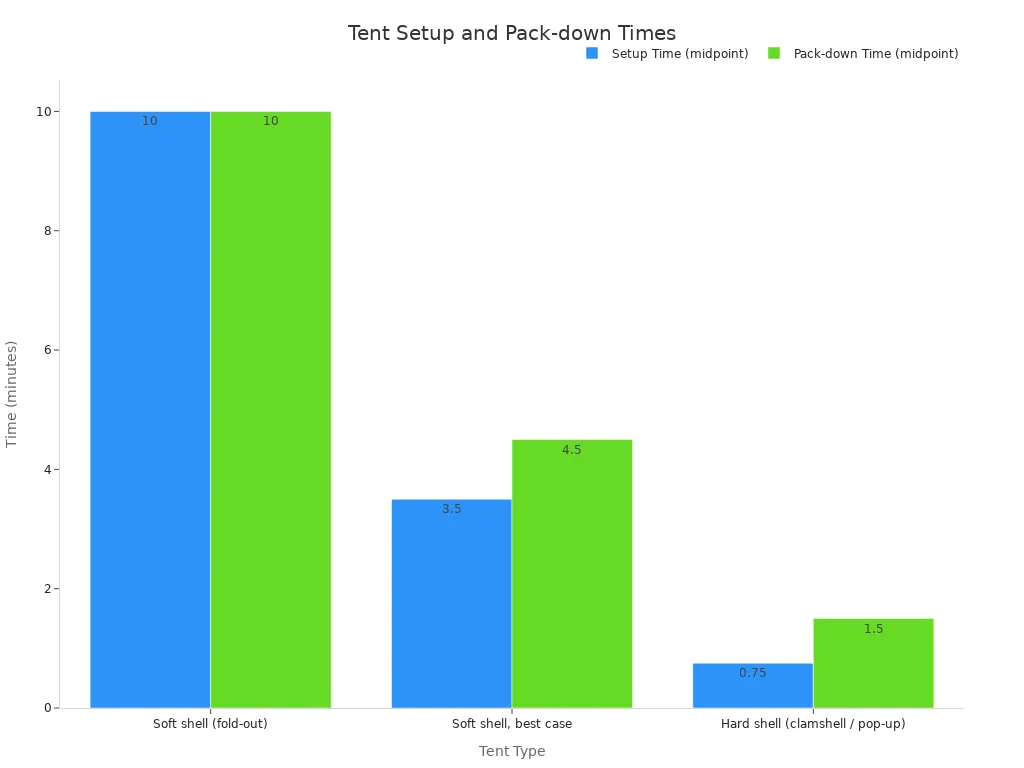
You have two main choices for sleeping off the ground: hard-shell and softshell rooftop tents. The core trade-off is simple. Soft shells give you more space and a lower price. Hard shells give you speed, durability, and efficiency. A hard shell pops up in 30–60 seconds, while a soft shell takes 3–10 minutes. Hard shells also weigh more, around 70–90 kg, so check your roof rack limits.
Before you read further, name your top priority: convenience, space, or budget. That answer shapes everything. In 2026, new hard shell roof tents and soft designs have closed many old gaps. Your choice now comes down to fit, not category.
Soft shell tents give you more space and a lower price.
Hard shell tents set up in 30–60 seconds for quick camp moves.
Soft shell tents take 3–10 minutes to set up and pack down.
Hard shell tents handle storms and wind better than soft shells.
Soft shell tents often weigh less and fit smaller vehicles.
Hard shell tents cost more but save fuel on long drives.
Choose a soft shell for family base camps and tight budgets.
Choose a hard shell for touring and rough weather.
A soft shell rooftop tent unfolds like a book. You release the travel cover, and the folded platform swings out over your ladder side. That fold-out geometry is the secret behind the roomy feel of soft shell rooftop tents. The floor panel doubles the footprint once it opens, so the sleeping area grows well beyond the footprint of most hard shell rooftop tents.
The body is heavy-duty canvas or ripstop fabric stretched over aluminum poles. A zipped travel cover protects everything on the highway. That cover keeps rain and road grime out, yet you must remove it fully at camp. Some 2026 models use a hinged cover that stays attached, which trims a minute or two off every setup.
You climb in through a wide door with a zip-down panel. The ladder hooks onto the base rail and telescopes to the ground. Check the ladder angle before you climb. A steep ladder feels shaky at night, so extend it one rung further than you think you need.
Speed is the weak spot of this design. A soft shell rooftop tent almost always takes five minutes or more to set up and even longer to pack away. Expect 5 to 15 minutes in real conditions. Wind, rain, and cold push that figure higher. Removable covers, separate fly sheets, and guy lines eat the most time.
Practice pays off, though. Even soft shell tents like the OVS Nomadic series set up in two to three minutes once you've practiced a few times. Pack-down runs a little longer, since you must fold fabric neatly and re-zip the cover.
A hard shell tent can be ready to sleep in within 30 to 60 seconds, whereas a soft shell tent almost always takes five minutes or more to set up and even longer to pack away.
Space is where soft shell roof tents shine. The fold-out floor gives you a bigger mattress and standing room near the door. Capacities run from 1 to 6 people, with a wider mattress range than hard shell models.
Model | Sleeping Capacity | Interior Dimensions |
|---|---|---|
OVS Nomadic 4 Extended | 4-5 person | 122" x 75" |
OVS TMBK 3 | 3 person | N/A |
Smittybilt Gen2 Overlander XL | 3-4 person | N/A |
Tuff Stuff Elite 5-Person | 5 person | N/A |
Eezi-Awn Series 3 | 2-3 person | N/A |
Soft-shell rooftop tents are cheaper than hard shells, and they usually weigh less too. That lighter load suits smaller vehicles and simpler roof racks. Weigh the soft-shell rooftop tent pros and cons for yourself: you trade setup speed and aerodynamics for space and savings. For a family or a base camp, that trade often wins.
A hard shell gives you a stronger, more stable structure than fabric walls ever can. That rigid body shrugs off storms, slices through headwinds, and saves fuel on the highway. You also get a convenience premium: the tent opens faster and easier, and you pay more for that privilege. Weigh the hardshell rooftop tent pros and cons with that premium in mind.
Hard shell rooftop tents use three main mechanisms, and each one changes how the tent feels at camp.
Mechanism | How It Works | Setup Characteristics |
|---|---|---|
Pop-up | Roof lifts vertically like a box lid; gas struts assist the lift; walls stay near-vertical | Fastest setup, simple unlatch-and-nudge operation, compact when closed |
Wedge | Shell pivots open at one end, forming a triangle; the high end gives headroom | Slightly longer setup; very aerodynamic when closed; headroom tapers at one end |
Hinged / Clamshell | Hinges run along one side; the top shell lifts over like a book | More involved setup; bulkiest when closed; largest, most consistent interior room |
Pop-up hardshells rise vertically with gas struts doing the heavy lifting. Unlatch, nudge, and the roof lifts straight up with near-vertical walls.
Most hard shell roof tents use aluminum, fiberglass or FRP, or ABS plastic. Aluminum shells stay light and resist dents well. Fiberglass and FRP shells offer stiff panels with a smooth finish. ABS plastic shells cost less and handle knocks without cracking. Each material suits a different budget and climate.
A hard shell seals along a continuous gasket, so rain and dust have few entry points. Check the gasket condition before every season. A worn seal lets water creep in during a downpour.
This is where a hardshell rooftop tent earns its price. You unlatch the latches, nudge the shell, and the gas struts finish the job. A hard shell rooftop tent reaches sleep-ready in 30 to 60 seconds. That quick setup matters when you arrive late or move camp daily. The fast and simple setup also means less wrestling with fabric in the rain.
The rigid shell takes wind loads that fabric walls cannot match. Hard-shell rooftop tents hold their shape in gusts and shed snow instead of sagging under it. Fewer moving fabric parts mean fewer failures over the years.
A closed hard shell roof tent sits low and smooth, so air flows over it cleanly. That shape cuts drag compared with a folded soft shell. Less drag translates into better fuel efficiency on long drives. Soft shell roof tents and soft-shell rooftop tents cannot match that profile. A softshell rooftop tent also takes longer to stow. For touring, a hard shell roof tent wins on efficiency. Softshell rooftop tents still win on space. Hard shell rooftop tents and hard-shell rooftop tents suit travelers who move often. Hardshell rooftop tents and soft shell rooftop tents split buyers neatly. Compare hard shell vs soft shell rooftop tents by your own habits. This rooftop tent guide keeps the choice practical.
You have seen how each design works on its own. Now line them up against each other. The table below pulls the major differences between hardshell and softshell tents into one view. Read across each row and ask which column sounds more like your camping week.
Attribute | Hard Shell | Soft Shell |
|---|---|---|
Setup time | 30–60 seconds | 3–10 minutes |
Pack-down | Fast, one or two latches | Slower, fabric must fold and cover must zip |
Interior space | Compact, consistent | Larger footprint, roomier near the door |
Sleeping capacity | Usually 2–3 people | 1–6 people |
Durability | Rigid shell, fewer wear points | Fabric body, needs care over time |
Weather resistance | Strong in extreme conditions | Adequate, weaker in extremes |
Aerodynamics | Low, smooth profile | Taller folded profile, more drag |
Weight | 45–90 kg | 54–67 kg |
Storage when closed | Bulky shell, fixed shape | Folds slimmer, easier to store |
Price (2026) | $1,850–$4,000+ | $900–$2,500 |
Best use | Touring, quick stops, harsh weather | Base camps, families, tight budgets |
Setup separates these two designs more than anything else. A hard shell rooftop tent opens in 30 to 60 seconds. You unlatch it, give the shell a nudge, and the gas struts do the rest. A soft shell rooftop tent asks for 3 to 10 minutes of real work. You pull the cover, unfold the platform, raise the poles, and stake the fly.
Space flips the result. Soft shell rooftop tents win on interior room because the fold-out floor doubles the sleeping area. You get wider mattresses and room for three, four, or even six sleepers. Hard shell rooftop tents keep a fixed footprint, so most sleep two or three people comfortably. If you camp with a full family, the soft shell rooftop tent gives you the floor plan you need.
Durability favors the rigid design. Hard shell rooftop tents build their bodies from sturdy materials such as ASA or ABS plastic with a Line-X exterior, or from all-aluminum construction. That build resists harsh weather and long-term wear. Soft shell rooftop tents rely on canvas and poles, so they may need added protection, like a tent cover, to extend their lifespan.
Weather resistance follows the same pattern. A hard shell rooftop tent handles extreme conditions better, and its solid body carries higher wind ratings because it moves less. The design also runs quieter. Solid walls cut canvas rustling in strong wind, and insulated roof interiors dampen the sound of rain. Heat escapes more slowly through an ABS or fiberglass shell, which helps on cold, wet, windy nights. Soft shell roof tents stay adequate in normal weather, yet they struggle more when conditions turn ugly.
Aerodynamics round out the row. A closed hard shell roof tent sits low and smooth, so air flows over it cleanly and drag stays low. A folded soft shell roof tent stands taller and catches more wind. On long highway drives, that difference shows up at the fuel pump.
Weight splits down the middle. Soft shell rooftop tents average 54–67 kg, roughly 9–14 kg lighter than their rigid cousins. Hard shell rooftop tents span 45–90 kg, since aluminum and fiberglass frames plus heavy shell materials add mass. Check your roof rack limit before you pick either one.
Tent Type | Weight Range | Average Weight |
|---|---|---|
Soft Shell | ~9–14 kg lighter than hard shell | 54–67 kg |
Hard Shell | 45–90 kg | Heavier due to aluminum/fiberglass frames and heavy materials |
Storage favors the softshell rooftop tent. It folds slimmer and takes less garage space between trips. The hardshell rooftop tent keeps a bulky fixed shape, so plan shelf or rack room for it.
Price draws the clearest line. Soft shell rooftop tents run $900–$2,500 in 2026. Hard shell rooftop tents start at $1,850 and climb past $4,000. You pay a convenience premium for speed and a rigid body.
Tent Type | Price Range (2026) |
|---|---|
Soft shell rooftop tents | $900 – $2,500 |
Hard shell rooftop tents | $1,850 – $4,000+ |
Use cases follow the numbers. Choose a softshell rooftop tent for base camping, big groups, and tight budgets. Choose a hard shell rooftop tent for touring, daily camp moves, and rough weather. Neither option loses here. Each one simply fits a different trip.
The shell material shapes how your tent ages, how much it weighs, and what you pay. Three materials dominate the market today. Each one brings real strengths and a few honest drawbacks. Read each against your climate, your vehicle, and your budget.
Aluminum gives you the toughest shell for its weight. It resists corrosion, so coastal trips and wet seasons treat it well. Premium rugged tents often use aluminum for exactly that reason. You get a shell that shrugs off branches and hail without cracking. The metal also holds its shape in strong wind, which keeps the seals tight.
The trade-off is cost. Aluminum shells sit at the top of the price range. They can also show dents after a hard knock. A dent rarely affects function, yet it stays visible on the smooth surface. If you tour rough roads and want a shell that lasts, aluminum earns its premium.
Fiberglass and FRP shells deliver strong panels with good insulation. The material holds heat in on cold nights better than a thin plastic shell. It also repairs easily. A crack in fiberglass takes a patch and some resin, and you're back on the road.
Weight is the catch. Fiberglass can run heavier than ABS or aluminum. That extra mass matters on smaller vehicles with tight roof limits. Check your rack rating before you commit. For a stable, repairable shell on a larger rig, fiberglass makes a solid pick.
ABS plastic keeps weight down and cost low. It handles everyday knocks without cracking, which suits weekend campers and budget builds. Many entry-level hard shell roof tents use ABS for that reason. The lighter shell also leaves more payload for gear.
Two weaknesses deserve your attention. ABS can turn brittle in extreme cold, so winter campers should think twice. It may also fade under prolonged harsh sun. A cover or a shaded parking spot helps. Treat an ABS shell well and it serves you for years.
Here's the quick view:
Material | Pros | Cons |
|---|---|---|
ABS Plastic | Lighter weight; lower cost | Can become brittle in extreme cold; may fade under prolonged harsh sun |
Fiberglass | Strong; good insulation; easily repaired if cracked | Can be heavier than ABS or aluminum |
Aluminum | Very strong; lightweight relative to strength; corrosion-resistant; common on premium rugged tents | More expensive; may show dents |
Whichever material you choose, match it to your climate and your roof limit. A rooftop tent is a long-term purchase. The shell decides how well it holds up.
You've seen the specs. Now match them to the way you actually camp. A simple rule of thumb cuts through most of the confusion. If you base-camp three or more nights in one spot, or you sleep three to four people, a soft shell usually wins on space and value. If you break camp every morning and hate fiddling with fabric, a hard shell pays you back in minutes.
Families and base campers get the most from soft shell rooftop tents. The fold-out floor gives kids room to move and parents a wider mattress. You park for several nights, so the longer setup costs you little. One owner reports 15–20 minutes of work, and that stings on a one-night stop. Stay put for a week, though, and you set up once.
Budget-minded buyers also fit here. Soft-shell rooftop tents are cheaper, and they often run 30–50 lbs lighter than a comparable hardshell. That lighter load suits smaller cars and trucks. The closed footprint stays compact too, which helps when your garage or rack space is tight.
Know the trade-offs before you commit. The travel cover handles weather and aging worse than a rigid shell, and mildew can creep in if you pack it wet. You must store the cover somewhere during setup. Folding the fabric back neatly often takes two people, and rain or heat makes that chore worse. Window flies can flap loudly in wind, which ruins sleep on gusty nights. Most soft models also can't carry crossbars on top, so you lose rooftop cargo space.
Campers who move daily belong in a hard shell rooftop tent. One owner clocked about 4 minutes to set up and roughly 5 minutes to break down. That quick setup changes how you travel. You can roll into camp at dusk, sleep, and leave at dawn without dread.
Solo travelers and couples fit well too. A hardshell rooftop tent keeps a modest interior focused on efficiency, and some models let you leave bedding inside. The tapered shell slices through wind and improves gas mileage. You also keep some roof utility, since you can still strap a paddleboard or surfboard on top.
The drawbacks are real. Weight runs 150–180 lbs on many models, which may exceed your roof or gutter capacity. The shell occupies the whole roof, so extra cargo space disappears. Aluminum models sometimes add load bars, but reaching them is awkward. Accessory mounting is easier on a hardshell, though, with double-channel designs that accept awnings.
Run these checks before you buy either design. Start with the three numbers that decide whether a rooftop tent fits your car: your vehicle's dynamic roof load rating, your rack system's rating, and the tent's empty weight plus sleepers and gear. Factory roofs and racks typically handle about 100–165 lbs dynamic and 600–800 lbs static. A 100–200 lb tent plus two adults and bedding at 350–450 lbs can blow past those limits on a compact SUV.
Specification | What to Check |
|---|---|
Sleeping capacity | Ratings run optimistic; plan one fewer sleeper than rated |
Mattress | Most ship with 2"–3" foam; side sleepers may want a topper |
Ladder | Aim for a 60–70° angle and confirm it reaches the ground |
Installation | Space crossbars 32"–48" apart; re-torque U-bolts after the first 100 miles |
Fuel economy | Expect a 1–4 mpg loss; tall softshells cost the most |
Garage clearance | Measure your door height; many setups fail a standard 7' door |
Budget | Entry softshell $1,000–$1,800; mid-range $1,800–$3,000; premium hardshell $3,000–$5,000+ |
One forum member compared a Tepui Ruggedized Autana 4 at about $2,950 and 240 lbs with 360g fabric against a Treeline at about $2,800 and 175 lbs with 380g fabric and an aluminum honeycomb base. The lighter Treeline used heavier fabric, while the Tepui offered built-in sky panels. Fabric weight, base construction, and total weight are concrete specs worth lining up side by side.
Weigh your own habits against these numbers. Setup frequency, passenger load, climate, and budget all point toward one design. Choose the tent that matches your camping style, not the label on the box.
The trade-off stays simple. Soft shell rooftop tents give you space and value. Hard shell rooftop tents give you speed, durability, and efficiency. Neither one wins outright.
Weigh your own priorities against the comparison table. How often will you set up? How many people and how much gear ride along? What does your vehicle allow? Which climate will you camp in? What budget feels right? Your answers point to one design.
Here is the bottom line on hardshell vs. soft-shell rooftop tents: the bottom line is fit, not category. Match the rooftop tent to your camping style. A softshell rooftop tents buyer and a hard-shell rooftop tents buyer can both camp well. Soft shell roof tents and hard shell roof tents each serve their own trips.
Plan on 30 to 60 seconds. You unlatch the shell, give it a nudge, and the gas struts lift the roof. Pack-down runs just as fast, often a minute or two. That speed pays off when you arrive late or move camp every morning.
More than most people expect. The fold-out floor doubles your sleeping footprint, so mattresses run wider and capacities reach up to six people. You also get standing room near the door. A hard shell keeps a fixed footprint, usually sleeping two or three.
Check three numbers first: your vehicle's dynamic roof load rating, your rack rating, and the tent's weight plus sleepers and gear. Factory roofs often handle about 100–165 lbs dynamic. A heavy tent with two adults can exceed that on a compact SUV.
Aluminum resists corrosion and handles knocks without cracking, which is why premium rugged tents use it. Fiberglass insulates well and repairs easily. ABS keeps weight and cost down, though it can turn brittle in extreme cold. Match the material to your climate.
Yes, generally. A closed hard shell sits low and smooth, so air flows over it cleanly and drag stays low. A folded soft shell stands taller and catches more wind. Expect a 1–4 mpg loss either way, with tall soft shells costing the most.
Some hard shell models let you keep bedding in place when you close up. That saves time every morning. Soft shells usually require you to strip the mattress area before folding the platform and zipping the cover.
Soft shells run $900–$2,500. Hard shells start at $1,850 and climb past $4,000. Entry softshells sit around $1,000–$1,800, mid-range models $1,800–$3,000, and premium hardshells $3,000–$5,000 or more.
A soft shell usually wins here. The fold-out floor gives you a wider mattress and room to move, and you likely stay put for several nights. Setup takes a few minutes, but you do it once per trip instead of every morning.