Views: 0 Author: Site Editor Publish Time: 2026-07-10 Origin: Site
Small patios, apartment balconies, and narrow decks often force a frustrating choice. Homeowners usually decide between creating a functional dining space and maintaining clear navigational flow. You should not have to sacrifice daily movement just to enjoy a meal outside. Evaluating whether the flexibility of a Folding aluminum table outweighs the structural permanence of stationary furniture becomes a critical decision point. Heavy, fixed dining sets quickly consume valuable square footage. They leave little room for other activities. This turns a relaxing balcony into a cramped obstacle course. In this guide, we evaluate these options by focusing on footprint efficiency, material resilience, and multi-functional use rather than pure aesthetics. You will discover how specific shapes improve traffic flow. We will also reveal how to match weather-resistant materials to your unique environmental challenges.
Flexibility vs. Stability: A Folding aluminum table maximizes square footage but requires strategic material choices like Carbon steel to avoid wind-instability.
Clearance is crucial: A Folding aluminum table still requires a minimum of 24 to 36 inches of peripheral clearance for seating and movement.
Size dictates capacity: Stick to realistic dimensions—a 60cm table is for 1–2 people, 90cm for 2–4 people, and 120cm for 4–6 people.
Not just for home: High-quality Roll-up camping tables seamlessly transition from balcony dining to off-site use.
Fixed outdoor furniture dictates how you use a small space entirely. It remains a dining area even when nobody is eating. A fixed heavy table claims permanent dominion over your limited square footage. If your patio measures just eight feet by ten feet, a stationary dining set consumes more than half your usable area. You lose the ability to repurpose that zone for other daily activities.
This lack of versatility often makes small outdoor spaces feel cluttered and uninviting. The permanence penalty is real. Homeowners frequently stop using their balconies because navigating around bulky furniture becomes a daily chore. A fixed setup removes your spatial freedom.
The folding advantage directly counters this issue. It allows a single space to transition through multiple uses daily. You can set up a morning coffee station at sunrise. By afternoon, you can collapse the furniture to create an open yoga space. You dictate the function of the space, not the furniture.
Many buyers hesitate because they associate folding furniture with flimsy plastic event accessories. The modern hybrid compromise solves this completely. Choosing a high-quality folding outdoor table means investing in a primary fixture. It acts and looks like permanent furniture but retains the ability to be stored. You treat it as a steadfast design element that simply gets out of the way when necessary.
Treating a residential balcony like a sprawling commercial dining patio.
Buying unsuitably large sizes that prevent natural walking paths.
Failing to measure chair push-out zones before purchasing fixtures.
Understanding weather realities is critical for small elevated spaces. Apartment balconies often act as wind tunnels. A standard Folding aluminum table must be evaluated for wind shear. A sudden gust can easily lift a poorly designed structure. You must assess the weight-to-surface-area ratio carefully before purchasing.
Look for slatted tops that allow wind to pass safely through the unit. Solid surfaces catch wind like a sail. Stable materials perform much better in these turbulent environments. A Carbon steel frame offers excellent natural wind resistance for stationary setups.
Storage feasibility requires exact measurements before you commit. Measure your vertical storage constraints carefully. Does the unit fold entirely flat? Sometimes poorly designed hardware creates a bulky folded profile. A table might fold in half but still measure six inches thick. This thickness quickly ruins your storage plans behind a sofa or inside a narrow utility closet.
Hardware durability separates premium options from seasonal disposable units. Moving parts represent potential points of failure. Evaluate hinges, locking mechanisms, and the track systems closely. Look for strong, rust-managed hardware in Aluminum alloy or Carbon steel. Rusty hinges will eventually seize and destroy the folding mechanism.
Component | Risk Factor | Recommended Solution |
|---|---|---|
Tabletop Design | Wind uplift on elevated balconies | Choose slatted surfaces or a heavier Carbon steel base |
Folding Hardware | Rust and mechanical seizing | Demand Aluminum alloy or coated Carbon steel hinges |
Collapsed Profile | Unable to fit in small closets | Measure exact folded depth before buying |
Table geometry and realistic product dimensions play a massive role in spatial efficiency. You cannot force a large square peg into a small round hole. When planning your layout, it is critical to adhere to standard logical sizes: a 60cm table is perfectly tailored for 1–2 people, a 90cm table comfortably hosts 2–4 people, and a 120cm table is ideal for 4–6 people. Avoid any unreasonably large sizes that will overwhelm your balcony.
Round tables work best for square balconies. A circular design eliminates sharp corners entirely. This improves traffic flow dramatically in tight areas. Round shapes make it much easier to squeeze in an extra chair without forcing guests against a railing.
Square or rectangular tables serve narrow decks perfectly. You can push them flush against a wall or railing when only one or two people are dining. This creates a highly efficient linear footprint. Consider bar-height options over standard dining height. Bar-height tables draw the eye upward naturally. This simple visual trick makes small spaces feel much larger. Higher tables often allow coordinating stools to tuck entirely underneath. When closed, a bar-height small fold away table leaves your walking path completely unobstructed.
Select a 60cm, 90cm, or 120cm footprint based purely on actual occupant numbers.
Walk around the taped area to ensure the shape matches your natural movement patterns.
Account for outward-swinging doors that might hit the table.
Your chosen material dictates how long your furniture survives outdoor conditions. Aluminum alloy is the mainstream choice, providing incredible rust-proof benefits. It is highly portable, easy to carry, and perfect for a Roll-up camping table. However, this lightweight nature requires secure storage in high-wind zones. You must tether it or fold it away during severe storms.
For those prioritizing stability, Carbon steel offers maximum wind resistance and longevity. It is the stable choice that stays exactly where you put it. Carbon steel is exceptional for balconies prone to heavy gusts, though it requires occasional maintenance to prevent rust if the protective coating is scratched.
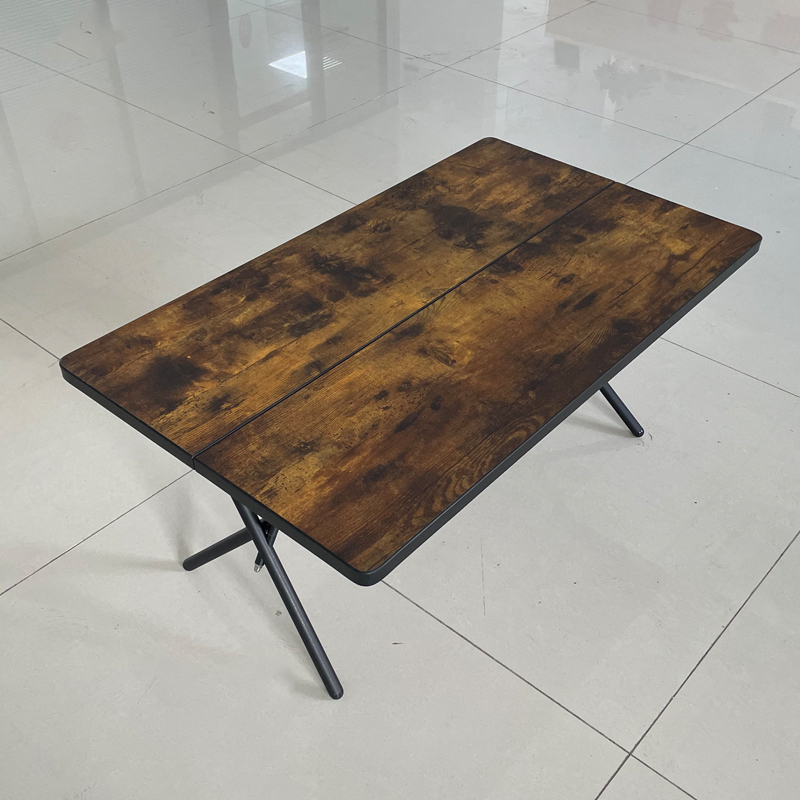
If you prefer a refined aesthetic, a Wood / MDF top is the premier choice for glamping and styled patio setups. It possesses a beautiful, natural look that elevates the outdoor dining experience. While it provides excellent visual weight, it may require a protective cover to shield it from harsh, prolonged moisture.
If you plan to move your furniture frequently between different locations, a portable outdoor table made of Aluminum alloy offers the safest balance between resilience and ease of transport.
Material Type | Primary Scene | Wind Resistance | Portability |
|---|---|---|---|
Aluminum alloy | Mainstream / Travel | Moderate | Excellent |
Carbon steel | Stable / Windy Balconies | Very High | Low |
Wood / MDF top | Glamping / Aesthetics | Moderate | Moderate |
Let us apply these design principles to specific real-world environments. Different living situations demand entirely different folding mechanisms, materials, and dimension strategies.
Balconies usually feature strict depth constraints. You rarely have more than five feet of outward clearance. Prioritize a weather-resistant Folding aluminum table or a heavy Carbon steel setup for stability. A 60cm table is the optimal choice here, providing a perfect coffee and dining spot for 1–2 people without blocking the door or railing.
Ground-level patios typically require more flexibility for entertaining guests. Look for a modular design featuring a Wood / MDF top for a premium glamping aesthetic. A 90cm table scales seamlessly throughout the day. It functions perfectly to accommodate 2–4 people while keeping the patio open and inviting.
Off-grid travel demands extreme efficiency and durability. You must prioritize a compact camping table designed specifically for rugged use. A 120cm Roll-up camping table ensures you have enough room for 4–6 people at the campsite. Aluminum alloy construction is non-negotiable here, as every extra pound affects your vehicle's payload limits and maneuverability.
For balconies: Focus on a 60cm (1–2 people) Folding aluminum table and stable Carbon steel materials.
For patios: Focus on a 90cm (2–4 people) format and a Wood / MDF top for elevated styling.
For nomadic use: Focus on a 120cm (4–6 people) Roll-up camping table crafted from Aluminum alloy.
A Folding aluminum table or Roll-up camping table is inherently better for small spaces, provided the buyer prioritizes commercial-grade hardware and scene-appropriate materials over cheap temporary solutions. You gain the power to adapt your limited square footage daily without feeling cramped.
Next Steps for Buyers:
Measure your space to ensure a 60cm, 90cm, or 120cm format meets your actual seating capacity.
Assess local wind conditions to narrow down between Aluminum alloy, Carbon steel, or a Wood / MDF top.
Determine your exact vertical storage capacity before selecting a folding mechanism.
A: Always align your dimensions with realistic usage: a 60cm table is perfectly suited for 1–2 people, a 90cm table comfortably hosts 2–4 people, and a 120cm table is ideal for 4–6 people. Unreasonably large sizes will instantly overcrowd a small patio or balcony and should be avoided.
A: It depends entirely on your scene. Aluminum alloy is the mainstream choice due to its high portability and rust resistance. If you have a windy apartment balcony, a stable Carbon steel table is highly recommended to prevent wind-uplift. For a luxury glamping aesthetic, a Wood / MDF top is perfect but should be protected from harsh weather when not in use.
A: Plan for at least 24 to 36 inches of peripheral clearance. For example, a 60cm table (1–2 people) fits efficiently in narrow zones, while a larger 120cm table (4–6 people) requires a much wider deck to maintain comfortable walkways and chair push-out zones.