Views: 0 Author: Site Editor Publish Time: 2026-08-12 Origin: Site
As overland and vehicle-based camping setups become more advanced, the structural integrity of the shelter becomes a primary failure point or a lasting asset. Buyers frequently misjudge the impact of shell material and construction on long-term durability. This oversight leads to field failures. You might experience shell warping, micro-cracking under road vibration, or binding lift mechanisms. Many also discover their setup fails to support auxiliary loads like solar panels. Evaluating a hard shell rooftop tent requires moving beyond aesthetic profiles. You must analyze panel materials, internal reinforcement, and aerodynamic rigidity. This guide breaks down how shell construction dictates performance. We examine how it impacts setup efficiency, longevity, and overall return on investment.
Rigidity defines how well a structure maintains its shape under external forces. Within the rooftop tent category, rigidity translates to three specific performance metrics. First, it means resistance to aerodynamic deflection at highway speeds. Second, it provides structural stability during high winds at camp. Third, it dictates dynamic load capacity for carrying extra gear. When you mount a large box to your vehicle's roof, it faces constant wind resistance, lateral G-forces on trails, and vertical impacts from potholes.
We can establish a baseline by comparing these structures to a soft shell rooftop tent. Soft shells utilize a heavy PVC cover and internal aluminum bows. They do not rely on a load-bearing external canopy. The fabric absorbs wind energy through tension and minor flexing. Hard shells operate on completely different mechanical principles. The outer shell itself is the primary structural component. If the shell flexes, the entire system degrades. You cannot rely on fabric tension to keep a hard shell stable.
Shell stiffness links directly to user outcomes. A rigid shell improves sleep quality by eliminating wind flap and reducing noise. It accelerates setup speed because rigid panels do not flex or bind when pulled down. Hardware longevity also increases. Stiff panels apply less lateral torque on gas struts and stainless steel hinges. When the shell holds its shape, the internal mechanisms operate exactly as engineered. Any Rooftop Tent built with a rigid outer casing must manage these forces without transferring stress to the mounting rails.
Manufacturers create ABS shells using vacuum-formed plastics. This process offers high manufacturing efficiency and allows for complex aerodynamic shaping. The material is lightweight and naturally resists water intrusion without additional coatings. Many entry-level models use this construction to keep overall vehicle payload low. You will often see these shells molded with sleek curves that mimic automotive rooflines.
The primary implementation risk involves thermal expansion and contraction. ABS plastic reacts significantly to temperature swings. A shell parked in direct summer sunlight will expand. When temperatures drop at night, it contracts. This constant movement stresses the mounting hardware and perimeter seals. Furthermore, UV degradation causes the plastic to lose its plasticizers over time. This leads to micro-cracking. You will notice the surface becoming chalky or brittle after prolonged sun exposure.
ABS panels work best for casual, fair-weather use. They suit users with strict vehicle payload limits. If you park your vehicle in a garage away from daily UV exposure, ABS remains a viable option. However, you must avoid mounting heavy accessories to these shells. The plastic lacks the internal structure to support point loads, meaning a bolted-on solar panel will eventually pull through the material.
Fiberglass shells consist of layered glass mats reinforced with structural resin. Manufacturers finish the exterior with a protective gel coat. This construction method creates a seamless, highly weather-resistant barrier. The layered approach allows engineers to add thickness at specific stress points, such as hinge mounts and latch catches. You get a shell that feels solid to the touch and resists wind deflection exceptionally well.
While fiberglass is rigid, it is also brittle. It weighs significantly more than ABS. The material is highly susceptible to spider-cracking from direct impacts. A low-hanging branch on a tight trail can easily fracture the gel coat. Excessive road vibration also causes structural fatigue, especially if mounting hardware is improperly torqued. Over-tightening a bolt can crush the fiberglass layers, compromising the waterproof seal. If you do crack a fiberglass shell on a tree branch, you can repair it using standard marine-grade epoxy and fiberglass cloth, followed by a fresh gel coat application.
Fiberglass offers excellent thermal properties and moderate rigidity. It insulates better than bare metal, keeping the interior slightly warmer in winter and cooler in summer. However, it requires regular maintenance. You must wax the gel coat periodically to prevent oxidation and UV degradation. Neglected fiberglass will chalk, fade, and eventually allow moisture to penetrate the resin layers.
Aluminum construction typically involves stamped sheets or dual aluminum skins sandwiching a structural honeycomb core. The honeycomb core acts as a continuous web of I-beams. This separates the inner and outer skins, multiplying the panel's stiffness without adding solid mass. Edge extrusions cap the panels, providing a solid mounting track for hardware. This is the same technology used in aerospace flooring.
The main implementation risks are higher upfront weight and potential thermal bridging. Aluminum conducts heat and cold rapidly. If the manufacturer does not properly insulate the interior skin, the tent will transfer freezing temperatures directly into the sleeping area. Condensation will form rapidly on bare aluminum surfaces, dripping onto your sleeping bag.
Aluminum honeycomb is the industry standard for extreme rigidity. It easily supports heavy top-loads like solar arrays or recovery boards. It resists structural fatigue on heavily corrugated off-road trails. The dimensional stability ensures that latches and hinges remain perfectly aligned after years of hard use. You can walk on a well-built aluminum honeycomb roof without causing permanent deflection.
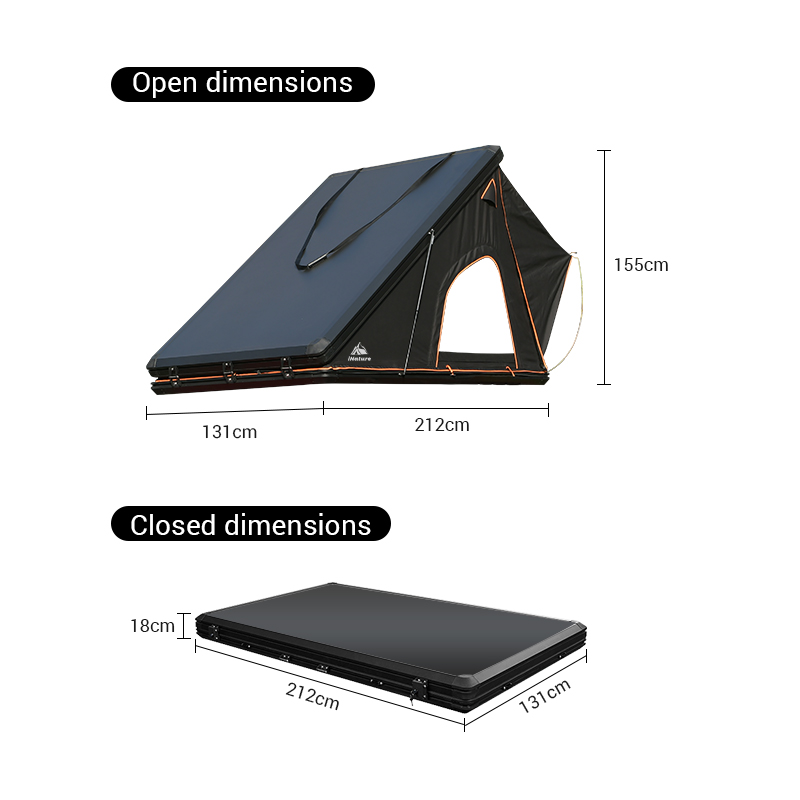
A clamshell rooftop tent is hinged at one end, creating a distinct wedge shape when open. This structural profile relies on a heavy-duty, continuous hinge along the front or side edge. Gas struts push the opposite end upward, tensioning the tent fabric between the top and bottom shells. The design is mechanically simple, utilizing fewer moving parts than other styles.
The single-axis hinge focuses massive mechanical stress at the base. The upper panel must resist twisting when opened in crosswinds. If the upper shell lacks rigidity, the wind will torque the panel, potentially bending the gas struts or snapping the hinge rivets. The wedge shape naturally deflects wind, but only if the shell maintains its flat profile. A flexing roof will cause the fabric to slacken, leading to noise and weather ingress.
Clamshell designs are generally more rigid than other architectures. The continuous connection at the hinge limits lateral movement. When you point the wedge into the wind, the aerodynamic profile pushes the shell downward, stabilizing the entire structure. This makes clamshells highly favorable for exposed, high-wind environments where structural failure is a real threat.
A pop up rooftop tent elevates vertically on all four corners. It uses internal scissor mechanisms or four independent gas struts to lift the roof straight up. This provides uniform headroom across the entire mattress footprint, maximizing usable interior space. You can sit up at either end of the tent, making it ideal for multiple occupants.
The structural requirements for pop-ups are severe. Both the top and bottom panels must possess extreme lateral rigidity. Without a fixed hinge to anchor the roof, the structure is prone to the parallelogram effect. If the wind hits the side of the tent, the roof wants to sway laterally. The shell panels must hold the lift mechanisms perfectly vertical to prevent this swaying. Any flex in the base panel will translate to amplified movement at the roof level.
To combat lateral movement, pop-ups require thicker panel construction or heavy internal aluminum framing. The scissor lifts must bolt into reinforced channels. This necessary reinforcement often results in a heavier overall unit compared to a clamshell of similar footprint. If a pop-up shell flexes, the four struts will bind during closure, making it nearly impossible to pack away single-handedly. You will find yourself walking around the vehicle, pulling down each corner incrementally.
The market heavily favors ultra-thin slimline profiles. Buyers want maximum aerodynamic efficiency to preserve vehicle fuel economy. They also need low clearance to fit lifted vehicles into standard residential garages. Some modern shells measure less than six inches thick when closed. This low-profile look dominates current overland vehicle builds.
This aesthetic comes with a severe structural trade-off. Thinner profiles often sacrifice internal structural ribbing. Without deep corrugations or a thick honeycomb core, the overall rigidity drops. A flat, thin sheet of aluminum or ABS will oil-can at highway speeds. Oil-canning is the rapid flexing in and out of the metal, which creates a loud drumming noise inside the vehicle. Furthermore, slimline designs eliminate the internal void space. You lose the ability to store thick bedding, pillows, or a ladder inside the closed tent.
Precision hardware relies entirely on the shell's dimensional stability. Stainless steel hinges, heavy-duty gas struts, and locking latches operate on tight tolerances. They expect the mounting points to remain static. The shell acts as the foundation for these moving parts. If the foundation moves, the hardware fails.
If a shell flexes under tension, lift mechanisms bind. When you pull down on a flexible roof, the center bows inward while the edges remain elevated. This forces the gas struts out of their vertical alignment. The struts will scrape against their housings, bend, or fail prematurely. A flexing shell drastically reduces the speed and ease of use that originally draw buyers to hard shell designs. You end up fighting the tent during every pack-down.
Manufacturers must reinforce panel edges to manage closure tension. Quality designs use extruded aluminum channels around the entire perimeter of the top and bottom shells. These extrusions act like a rigid skeleton. They provide a solid backing for the rubber weather seals and a crush-proof mounting point for the closure latches.
Without edge framing, the shell will bow under the tension of the latches. When you clamp down the front of an unreinforced shell, the middle sections often lift slightly, breaking the weather seal. Dust and rain will penetrate the gap during transit. Extruded edges ensure the clamping force distributes evenly across the entire seal. You can visually inspect a tent for this feature by looking at the mating surfaces when the tent is open.
Highly rigid, impermeable shells create a perfectly sealed environment when closed. While this keeps rain out, it drastically increases internal condensation when occupied. Humans exhale significant moisture overnight. Unlike breathable soft shells, rigid aluminum or fiberglass panels trap this moisture inside. The moisture hits the cold inner surface of the shell and turns into water droplets.
You must mitigate this physical reality. Factory-installed closed-cell foam insulation on the ceiling is mandatory for aluminum shells. It acts as a thermal break, preventing warm, moist air from condensing against cold metal. Additionally, an anti-condensation mat under the mattress is required. This creates an air gap, allowing moisture that reaches the floor to evaporate rather than soaking into the mattress foam. If you camp in temperatures below 40 degrees Fahrenheit, the temperature differential between the inside and outside of the shell guarantees condensation. A 10mm anti-condensation mat creates the necessary airflow under your mattress.
Many users want to mount rigid residential solar panels, storage boxes, or recovery boards directly to the tent roof. This requires specific structural capabilities. You cannot simply bolt heavy gear to any flat surface. The dynamic load of a 40-pound solar panel bouncing on a dirt road multiplies the stress on the shell exponentially. The mounting points must distribute this load across a wide area.
Drilling into or overloading a non-honeycomb shell carries high risks. If you mount gear to an ABS plastic roof, the weight will cause the plastic to sag. Water will pool in the depression. Eventually, the mounting holes will elongate, leading to severe weather seal failure. Only aluminum honeycomb or heavily reinforced fiberglass shells possess the rigidity to support dynamic top-loads safely. Look for tents with integrated T-slot tracks extruded directly into the frame.
You must evaluate the interaction between the vehicle's roof rack, the tent's mounting rails, and the shell itself. Corrugated dirt roads send violent, high-frequency vibrations through the vehicle chassis directly into the tent base. If the base panel flexes, the mounting bolts will act like a saw against the shell material. This friction will eventually wear through the floor.
Poor fastening techniques guarantee failure. Using self-tapping screws into plastic or thin aluminum will result in stripped threads within hundreds of miles. Look for tents that use through-bolts. The hardware must include stainless steel backing plates to distribute the load across a wider surface area. When securing the tent to your roof rack, always use M8 stainless steel bolts paired with nyloc nuts. Standard zinc-plated hardware will rust after one season, and standard hex nuts will vibrate loose on washboard roads. The rigidity of the base panel dictates how well it handles these localized stress points.
Choosing the right construction requires balancing upfront investment against expected lifespan and resale value. A rigid, well-built tent acts as a long-term asset, while a flexible, poorly constructed shell becomes a recurring maintenance liability. You must assess your specific travel style, vehicle payload limits, and accessory requirements before making a selection.
| Shell Material | Rigidity Level | Weight Impact | Lifespan & Resale Value | Auxiliary Load Capacity |
|---|---|---|---|---|
| ABS Plastic | Low to Moderate | Lightest | Short lifespan (3-5 years); Low resale value. | None. Do not mount heavy gear. |
| Fiberglass | High | Heavy | Medium lifespan; Moderate resale value (requires gel coat maintenance). | Light loads only (flexible solar panels). |
| Aluminum Honeycomb | Extreme | Moderate to Heavy | Long lifespan (10+ years); High resale value. | High capacity (rigid solar panels, recovery gear). |
High rigidity usually means higher static and dynamic weight. Buyers must cross-reference the tent's weight with their vehicle's dynamic roof load limit. You must also verify the load rating of your crossbars or platform rack. Mounting a 180-pound aluminum tent on factory crossbars rated for 100 pounds creates a severe safety hazard, regardless of how rigid the tent shell is.
To properly evaluate a tent's structural integrity, follow these field-tested steps:
To finalize your setup and ensure long-term structural integrity, execute the following steps:
A: Yes. The rigid, impermeable materials create a perfectly sealed environment that traps moisture exhaled during the night. Proper ventilation, factory-insulated ceilings, and anti-condensation mats under the mattress are strictly required to manage this moisture.
A: You can only do this safely if the tent features an aluminum or structurally reinforced honeycomb shell. Mounting heavy, rigid panels on ABS plastic using poor fastening techniques causes the roof to warp, crack, or loosen under road vibrations.
A: Often, yes. Ultra-thin profiles frequently eliminate internal structural ribbing and deep corrugations to achieve their low height. This reduction in material thickness lowers overall rigidity, making the shell more prone to flexing at highway speeds.
A: Fiberglass is rigid but brittle. High-frequency road vibrations from corrugated trails can cause structural fatigue and spider-cracking in the gel coat, especially if the mounting bolts are over-torqued and crush the fiberglass layers.
A: Pop-up tents lack a fixed hinge to anchor the roof. Both top and bottom panels must possess extreme lateral rigidity to hold the four lift struts perfectly vertical. Thicker panels prevent the roof from swaying and binding the struts.
A: ABS plastic becomes increasingly brittle in sub-zero temperatures. The material loses its flexibility, making it highly susceptible to cracking if impacted or subjected to severe twisting forces while off-roading in freezing conditions.