Views: 0 Author: Site Editor Publish Time: 2026-08-14 Origin: Site
Even millimeter-level joint play at a hinge translates to significant lateral movement at the table's edge. This mechanical reality compromises usability in field environments. When you deploy an Outdoor Table on uneven ground, gravity and lateral forces immediately expose manufacturing shortcuts in the frame. Standard folding mechanisms prioritize compact storage over structural rigidity. Manufacturers leave excessive gaps in hinges and sliding components to ensure the table folds easily without binding. This leads to tolerance stacking. A fraction of a millimeter of axial play at the center hinge, combined with loose leg detents, results in inevitable wobbling under dynamic loads. In worst-case scenarios, off-axis stress causes catastrophic table collapse during use. Mitigating this movement requires a technical evaluation of joint clearances, locking mechanisms, and structural bracing before selecting or modifying your gear for reliable use.
Acceptable stability in field furniture is highly specific and measurable. A structurally sound frame should exhibit less than 5mm of deflection under a 20kg lateral load applied directly to the edge. Standard consumer tables routinely fail this metric. Their joints lack the necessary compression to resist shear forces. When you chop vegetables, clean a heavy cast-iron Dutch oven, or lean against the edge, the frame shifts. The internal components physically collide with their retaining pins. We measure this failure through lateral racking. If the tabletop moves independently of the feet planted on the ground, the joint clearances are too loose.
Joint clearance amplifies movement through the lever-arm effect. If a center hinge pin has a 0.5mm gap inside its bracket, that small amount of play does not stay localized. The table leg acts as a long lever. That 0.5mm gap at the pivot point easily translates to 2 to 3 centimeters of sway at the foot of the table. The longer the leg, the more exaggerated the wobble becomes at the base. You can observe this by holding the hinge tight and moving the leg. The pivot axis acts as a multiplier for every fraction of a millimeter of slop.
Tolerance stacking occurs when multiple folding points combine their individual clearances. A standard folding frame features a center fold, four leg hinges, and often telescoping extensions. If each of these eight connection points has 0.3mm of play, the systemic instability compounds. The frame twists independently of the tabletop, creating a loose, unpredictable surface.
Consider the breakdown of a typical four-leg folding frame under load:
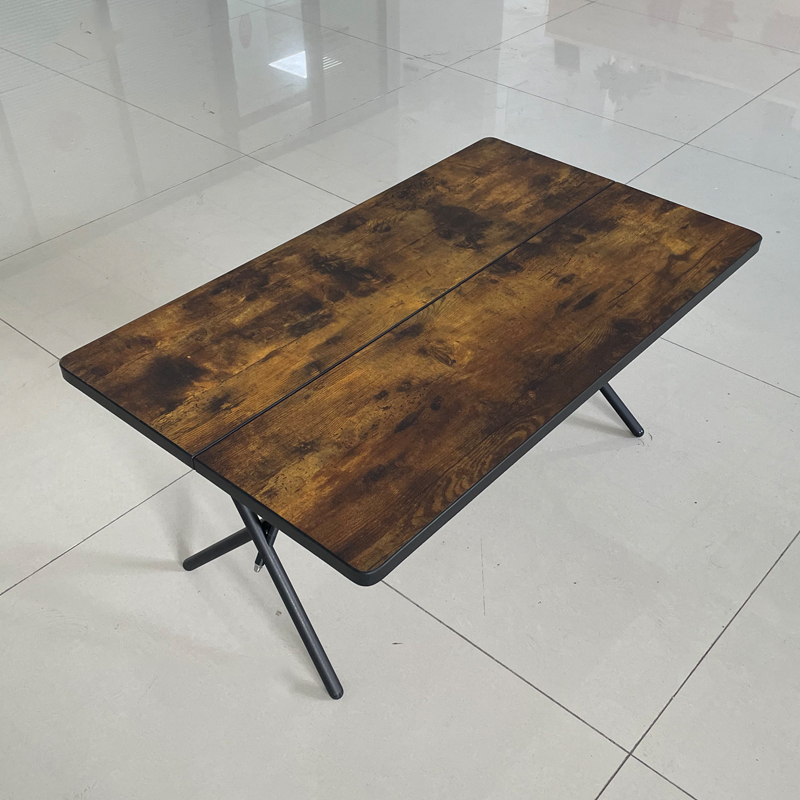
Surface design heavily impacts joint stress and overall rigidity. A solid bi-fold top inherently resists racking. The rigid panels act as structural shear webs when locked flat. Conversely, a roll up camping table relies entirely on the tension of its internal shock cords and the friction between the slats. Without a solid plane to distribute lateral forces, the underlying frame must absorb 100% of the twisting motion. Tight joint tolerances become even more critical here. If the frame lacks diagonal bracing, the roll-top design will shift under side loads.
Uneven terrain forces joints out of their designed load paths. When one leg sits lower than the others, the table frame twists. This off-axis loading applies torque directly to the hinge pins, prying them against their brackets. Over time, this twisting permanently deforms the soft metal housings. It exposes excessive clearances and permanently ruins the table's stability. You cannot expect a square frame to sit flat on rocks and roots without transferring that stress directly into the weakest points: the hinges.
| Hinge Gap Clearance | Estimated Lateral Deflection (at 70cm leg height) | Field Performance Impact |
|---|---|---|
| 0.1mm - 0.2mm | < 2mm | Rigid workstation; suitable for heavy loads and food prep. |
| 0.3mm - 0.5mm | 5mm - 15mm | Noticeable sway; acceptable for light dining, poor for cooking. |
| 0.6mm - 1.0mm | 20mm - 40mm | Severe wobble; high risk of collapse under dynamic lateral loads. |
| > 1.0mm | > 50mm | Structural failure; joints are deformed and require immediate repair. |
Engineering a stable folding surface requires balancing smooth operation with tight mechanical tolerances. Different joint types demand specific clearances to function correctly without introducing slop.
The pivot pin is the most critical component in any folding mechanism. The ideal gap for a pivot pin is a slip-fit tolerance, typically around 0.15mm to 0.2mm. A press-fit joint—where the pin is forced into the hole with zero clearance—is entirely unsuitable for field deployment. Dust, sand, and grit will immediately bind a press-fit joint, making the table impossible to open. However, anything exceeding a 0.3mm clearance introduces noticeable axial play. This allows the hinge to rock back and forth under load. We use feeler gauges to measure this gap. If a 0.4mm gauge slides between the pin and the bracket, the joint will fail under heavy use.
The structural geometry of the hinge dictates how weight is distributed. Most cheap tables use standard butt joints. Two flat edges meet, and the hinge pin sits directly below the seam. In a butt joint, the pin bears the entire downward force. Over time, the pin stretches the aluminum housing, creating a permanent sag in the center of the table.
Rule joints offer a massive structural advantage. In a rule joint, the mating surfaces feature an overlapping lip and a corresponding cove. When the table opens, this lip acts as a physical stop. Downward weight transfers directly through the solid overlapping material rather than the hinge pin. This geometry prevents center collapse and completely neutralizes downward joint play.
A folding camping table must operate flawlessly across extreme temperature fluctuations. Aluminum expands significantly in high heat. If an aluminum-on-aluminum joint is machined too tightly at room temperature, it will seize completely when left in the midday desert sun. Conversely, in freezing conditions, the metal contracts, widening the joint and introducing slop. Engineers account for this by using dissimilar metals. They place stainless steel pins inside aluminum brackets and maintain a strict 0.2mm clearance. This accommodates thermal expansion without sacrificing rigidity.
Because zero-clearance joints are impossible in folding furniture, mechanical additions must compensate for the necessary gaps. You must evaluate the specific features that actively neutralize joint movement once the table is deployed.
Triangulation is the most effective way to eliminate wobble. A square frame with loose hinges will always rack side to side. Adding a rigid cross-brace changes the geometry. A diagonal aluminum strut or a horizontal locking bar bypasses the hinge clearance entirely. It transfers the lateral load directly between the legs. Once the brace is locked under tension, the hinge clearances become irrelevant. The frame can no longer physically shift.
Primary hinge friction is never enough to keep a table stable. Mechanical leg locks are required to compress the joint. Over-center latches are highly effective. As you push the latch down, it pulls the joint faces together, compressing the 0.2mm clearance to absolute zero. Cam locks and threaded tensioners serve the same purpose on telescoping legs. They clamp down on the internal tube to eliminate all sliding play.
| Locking Mechanism | Clearance Reduction | Field Reliability |
|---|---|---|
| Push-Button Detent | None (Requires gap to operate) | Low; prone to shearing under heavy loads. |
| Threaded Collar | Complete (Compresses to zero) | High; immune to dirt, provides 360-degree clamping. |
| Over-Center Latch | Complete (Pulls joint tight) | High; fast deployment, excellent tension control. |
| Friction Hinge | Partial (Relies on rivet tension) | Medium; degrades over time as rivets stretch. |
Transit vibration destroys tight tolerances. When a folded table rattles inside an RV, van, or off-road vehicle, the metal components rub against each other. This high-frequency vibration acts like sandpaper, rapidly widening the joint clearances. High-quality frames utilize friction dampers to prevent this. Nylon washers placed between hinge brackets, PTFE shims inside sliding tubes, and high-density EVA foam standoffs keep the metal parts isolated. These dampening materials absorb the vibration, preserving the factory tolerances for years of heavy use.
Procuring reliable gear requires weighing portability against structural rigidity. Ultralight designs inherently sacrifice stiffness to shed weight. Understanding the mechanical trade-offs helps you identify which frames will survive harsh field conditions.
When evaluating an adjustable aluminum camping table, pay close attention to the telescoping leg extensions. To slide freely, the inner aluminum extrusion must be smaller than the outer tube, creating a necessary gap. How the table locks this gap determines its stability.
Micro-adjustable, articulating feet are critical for stability. If you place a rigid table on uneven ground, the frame will teeter. When weight is applied, the frame twists to meet the ground, applying massive off-axis stress to the primary hinges. Articulating ball-joint feet adapt to the terrain angle. Threaded leveling stems allow you to lengthen a single leg. This ensures all four corners bear weight evenly, protecting the hinges from twisting forces.
Thicker gauge materials allow manufacturers to machine tighter tolerances without the risk of the metal tearing under stress. A frame built from 1.5mm wall aluminum tubing will always exhibit less flex and hold tighter joint clearances than a frame using 0.8mm tubing. However, this dramatically increases the overall carry weight. You must decide if the application demands a rock-solid workstation or a lightweight picnic surface.
Factory hardware often dictates the lifespan of the table. Many manufacturers use soft aluminum rivets for their main pivot points to cut costs. After a few months of use, these rivets stretch and deform, introducing massive amounts of axial play. Look for frames assembled with stainless steel hardware, hex bolts, and brass or bronze bushings. These materials resist deformation and sustain their clearance integrity over thousands of folding cycles.
If your current setup exhibits excessive movement or poses a collapse risk, you do not necessarily need to replace it. Evidence-based modifications can restore stability and tighten worn clearances.
When you need immediate stability at camp, non-permanent fixes are highly effective. If an outdoor camping table wobbles due to uneven ground, do not force the frame to twist. Use wooden wedge shims under the floating leg to bridge the gap. Alternatively, run a ratcheting tension strap diagonally across the frame legs. Tightening the strap pulls the legs inward, pre-loading the hinges and temporarily bypassing all joint play.
Worn factory detents lead to catastrophic collapse under load. You can bypass a failing push-button lock by drilling a secondary hole straight through both the outer and inner telescoping tubes. Insert a high-tensile steel bolt through the hole and secure it with a wingnut. This physical bolt-and-nut locking mechanism entirely removes the reliance on internal friction. It physically locks the joint and guarantees the leg cannot collapse.
If the main hinge brackets have widened over time, you can retrofit the joint to take up the excess axial play. Disassemble the hinge and insert ultra-thin phosphor bronze or nylon shims between the moving metal parts. A 0.5mm nylon washer takes up the slack, stops metal-on-metal grinding, and immediately stiffens the folding action.
The most permanent upgrade involves removing cheap factory fasteners. Soft aluminum rivets will inevitably fail. You can replace them using basic hand tools to restore factory-level rigidity to an old frame.
A: The ideal clearance is a slip-fit tolerance between 0.1mm and 0.3mm. This specific gap prevents the aluminum folding camping table joints from binding due to thermal expansion in high heat, while remaining tight enough to prevent excessive axial play and lateral wobble.
A: You must use adjustable legs with independent cam locks and articulating leveling feet. Adjusting each leg individually ensures all four corners contact the ground evenly. This prevents off-axis stress from twisting the main hinges and exposing clearance gaps.
A: Sway occurs due to a lack of diagonal cross-bracing and inherent tolerance stacking. Multi-slat designs lack the shear strength of a solid tabletop. Without a rigid surface to distribute lateral forces, the underlying frame hinges absorb all the twisting motion.
A: No, factory rivets cannot be tightened once they stretch. The soft aluminum permanently deforms under load. To reduce movement, you must drill out the failing rivets and replace them with stainless steel shoulder bolts and nylon-insert lock nuts for adjustable tension.
A: Insert high-density EVA foam pads or adhere PTFE strips to the contact points. These materials act as friction dampers, absorbing transit vibration and preventing metal-on-metal wear that rapidly widens joint clearances during travel.
A: Push-buttons are generally less stable. They inherently require clearance between the pin and the hole to operate, which guarantees leg slop. For heavy loads, compression cam locks or threaded collars are superior because they clamp the tubes together, eliminating the gap entirely.
A: Use wooden wedge shims under the floating leg to bridge the gap to the ground. Alternatively, wrap a tensioning strap diagonally across the table legs and tighten it to pre-load the hinges, temporarily bypassing the internal joint play.