Views: 0 Author: Site Editor Publish Time: 2026-10-28 Origin: Site
Ever watched a heavy camp stove crash to the dirt because a table wobbled at the worst possible moment? The frustrating clatter of ruined dinner and spilled water is a scenario most campers want to avoid. Many buyers pick their outdoor gear purely based on price or aesthetic appeal. They completely ignore the hidden structural architecture.
The secret to a reliable setup lies almost entirely in the metal frame. Specifically, the profile thickness dictates performance. In this technical breakdown, we will examine how frame engineering directly impacts structural rigidity. This perspective will help you navigate the technical specs to choose your folding outdoor table wisely.
Thicker Profiles Equal Higher Load Capacity: A thicker metal wall significantly increases the downward weight a table can hold, safely supporting your cast-iron cookware and water jugs up to our standard 30 kg (66 lb) limit.
The Weight Trade-off: Thicker metal adds necessary structural rigidity. However, it inherently adds mass. Finding the exact balance is critical for portable gear, with our lightest all-aluminum models starting around a highly manageable 2.10 kg.
Shape Matters: Square or internally reinforced tubular profiles offer superior rigidity compared to standard thin round tubes.
Design Specifics: Tables with moving parts require specific profile thicknesses at the joints and hinges to prevent lateral swaying.
Terrain Adaptability: A rigid frame resists torsional twisting much better when placed on rocky or rough outdoor terrain.
When evaluating folding outdoor tables, the foundation of any reliable product lies in its material composition. Understanding why manufacturers choose specific metals or woods is the first crucial step in assessing overall quality and finding the right fit for your campsite.
Our lineup focuses on highly functional Roll-Up Tables and Folding Tables crafted from premium materials. While carbon steel offers exceptional ruggedness and durability for demanding campouts, and premium beech wood provides a classic, natural aesthetic perfect for upscale glamping, aluminum remains the overarching industry standard. Aluminum solves the portability challenge with an outstanding strength-to-weight ratio. Furthermore, it naturally forms a microscopic protective oxide layer when exposed to the elements, making it highly resistant to corrosion from sudden rainstorms or morning dew.
Compared to molded plastics, aluminum and steel maintain their structural integrity across extreme temperature variations. Plastics can become dangerously brittle in freezing temperatures or warp under intense summer UV exposure. This reliability makes carefully engineered metal frames the optimal choice for gear that must endure unpredictable wilderness conditions.
In manufacturing terms, a metal profile refers to the cross-sectional shape and the wall thickness of the extruded material used to build the frame and legs. It is not a solid block of metal. Rather, it is a hollow tube engineered to shed unnecessary weight while maintaining high structural strength.
The thickness refers to the actual measurement of the metal wall itself, typically ranging from 0.6mm to 1.5mm in the camping industry. Premium manufacturers engineer these profiles specifically to handle outdoor stresses. They calculate the exact thickness required to support a specified weight limit safely. When you are shopping for a reliable outdoor camping table, verifying the build quality of these load-bearing legs is absolutely critical.
Rigidity is not a subjective feeling. It is a highly measurable mechanical property. The gauge of the frame is the primary variable that dictates how a folding table behaves under physical stress.
The relationship between wall thickness and load-bearing capacity is exponential rather than linear. Consequently, an increase of just 0.2mm in wall thickness can drastically alter how much downward force a frame can withstand before flexing.
Imagine placing a 5-gallon water dispenser or a Dutch oven filled with chili on the surface. The downward force causes immediate stress on the legs and crossbars. A thicker wall distributes this kinetic energy more effectively. This prevents the metal from reaching its yield point, keeping your setup stable up to our recommended maximum load of 30 kg (66 lbs).
Profile Wall Thickness | Structural Rigidity Level | Load Distribution | Ideal Application |
|---|---|---|---|
0.6mm - 0.7mm | Moderate. Lightweight and highly portable. | Minimal. Best for static, lighter loads. | Light snacks, card games, basic prep. |
0.8mm - 1.0mm | High. Stable for dynamic tasks. | Balanced. Handles standard downward forces well. | Standard car camping, active food prep. |
1.1mm - 1.5mm | Maximum. No noticeable flex or sway. | Exceptional. Resists heavy kinetic energy. | Stable prep work, basecamps, overlanding. |
Rigidity is also about maintaining the original geometry of the frame over years of rough use. Ultra-thin metal under 0.8mm is highly susceptible to denting during transport. If a table leg is struck by a heavy cooler shifting in the back of a truck, a thin wall will easily dent.
In structural engineering, once a hollow tube sustains a dent, its integrity is permanently compromised. That dent acts as a stress riser. It becomes a weak point where the tube is likely to fold or buckle under pressure. Appropriately thick profiles resist these impact dents, preserving the table's overall rigidity for the long haul.
Campgrounds are rarely perfectly smooth. When gear is deployed on rocky or root-filled ground, the frame experiences torsional stress or twisting forces. If the metal profiles are too thin, the legs will flex outward or twist independently of one another. The result is a severe and frustrating wobble.
Conversely, appropriately thick frame walls provide high torsional rigidity. The frame acts as a single cohesive skeleton. It resists the urge to twist, keeping your cooking surface stable and reliable even when the earth beneath it is rough and uneven.
Designing outdoor gear requires balancing two opposing forces. Campers need an unyielding surface, but they also need to carry the item easily from the car to the campsite.
To meet modern demands, top-tier production facilities utilize advanced materials and complex extrusion geometries. This metallurgical approach allows structural engineers to optimize wall thickness, saving weight while successfully retaining the torsional rigidity of a much heavier setup.
For campers prioritizing speed and ease of transport, every bit of mass is scrutinized. Carrying a heavy, overbuilt frame is physically impractical. Advanced metallurgy and smart design solve this problem.
To create a functional ultralight folding camping table, engineers utilize high-tensile alloys to safely reduce wall thickness. Our lightest all-aluminum folding outdoor tables weigh approximately 2.10 kg, making them exceptionally easy to handle. Operating at a practical height of around 35 cm or 40 cm, these highly portable frames provide an excellent surface for lightweight backpacking stoves without adding excess bulk to your vehicle.
If you are setting up a multi-day basecamp or travelling in an RV, the physical weight of your gear becomes a secondary concern compared to undeniable stability.
In these situations, opting for robust frames with profile thicknesses ranging from 1.0mm to 1.5mm ensures the setup will not falter. These robust structures handle standard campsite tasks with zero structural strain, comfortably supporting up to 30 kg (66 lbs). The slight increase in physical weight translates directly into a lifetime of reliable, heavy-duty use.
Thickness is an undeniably critical metric. However, it does not work in isolation. The geometric shape of the extrusion dictates how effectively that thickness is utilized against physical forces.
The cross-sectional shape of the metal dictates how it handles stress. Round tubular profiles distribute weight evenly across their circumference, making them highly efficient for vertical load-bearing. However, square or rectangular profiles offer superior resistance to lateral side-to-side bending.
The flat sides and rigid 90-degree corners of a square tube create a strong backbone. Specifically, an 0.8mm thick square profile will often exhibit noticeably less lateral flex than an 0.8mm thick round profile. This makes square tubing highly desirable for heavy-duty main support legs.
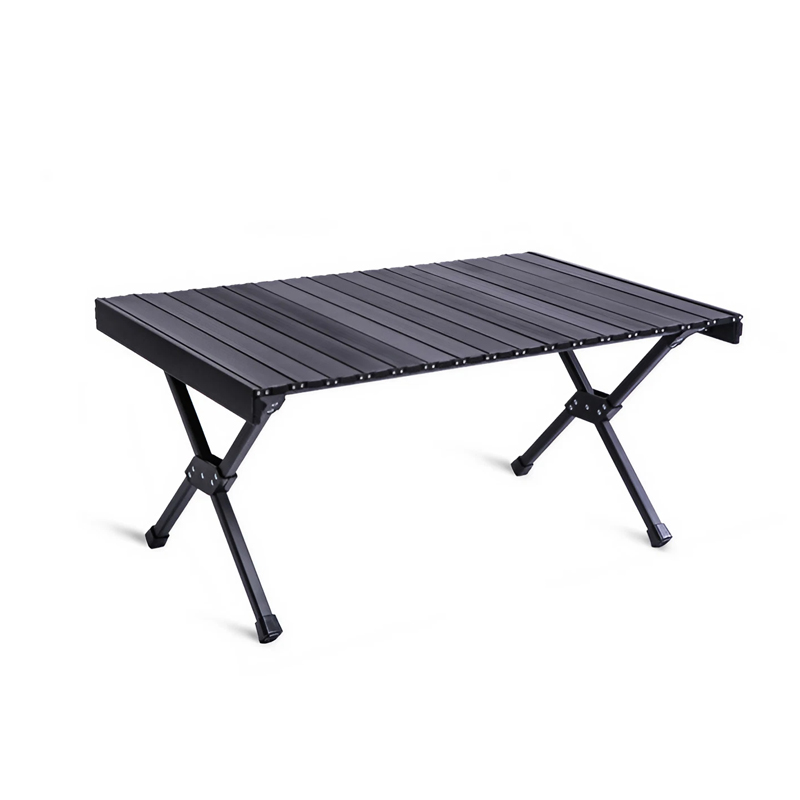
Intelligent architectural design can amplify the stiffness provided by the material. An X-frame structure utilizes the principle of triangulation.
Because triangles are structurally stable, they distribute applied force evenly through all three sides. By incorporating cross-bracing, manufacturers achieve exceptional rigidity. The geometry itself absorbs the stress, reducing the direct burden on the metal's wall thickness and keeping the table firmly planted.
Understanding the general principles of metal thickness is only the first step. Different styles require vastly different engineering approaches. By examining specific table types, we can see exactly how frame design affects real-world performance.
A roll up camping table presents a highly convenient engineering advantage. The top features an integrated series of slats that effortlessly roll out as a single connected surface—you do not need to assemble or snap in each slat individually. Because this flexible top provides an amazingly compact storage profile, the entire load-bearing responsibility falls securely onto the underlying base frame.
For this design to function without swaying, the primary horizontal support beams and vertical legs must utilize a sturdy profile, typically no less than 1.0mm. The base frame acts as an independent, fully rigid skeleton, seamlessly supporting the unrolled top.
When moving parts are introduced to a structural frame, maintaining rigidity requires precision engineering. This is the primary focus when designing an adjustable aluminum camping table. These models utilize telescoping legs, meaning a smaller inner tube slides inside a larger outer tube.
Black outdoor dining variations often feature these mechanisms to conveniently alter the tabletop height. Operating primarily around an in-demand height of 40 cm, with some options smoothly extending to 65 cm or lowering to 35 cm, these legs easily adapt to match your specific camping chair height or user preferences. Thicker wall profiles ensure that the locking mechanisms grip securely without deforming the metal, maintaining stability even at the maximum 65 cm setting.
Briefcase-style folding tables are incredibly popular for straightforward car camping. Because the tabletop folds directly in half, the center seam relies entirely on the outer rim and the hinge mechanism to prevent the structure from collapsing inward.
In these designs, the outer rim is a primary load-bearing component. A high-quality aluminum camping table of this style will feature a reinforced box-shaped profile that is appropriately thick. Importantly, this folding mechanism ensures that even a generously sized table packs down to an impressively compact storage size for transport.
Relying solely on marketing jargon can be misleading. Recognizing the physical indicators of a thin, poorly engineered profile can save you from purchasing a product that will fail during your trip.
One of the most immediate ways to assess wall thickness is the physical squeeze test. On standard tubular legs, grip the center of the longest exposed section and squeeze firmly with your hand. A properly engineered profile of 0.9mm or thicker will yield absolutely zero deflection. If you can feel the metal slightly compress or ovalize inward, the gauge is likely too thin.
Visually, inspect the pre-drilled holes where rivets are installed. On ultra-thin profiles, punching these holes often leaves slight indentations or micro-warps around the opening. A thick, high-quality profile boasts perfectly clean, flush holes with no surrounding metal distortion.
The rigidity of thick metal is entirely negated if the connection points are flawed. When inspecting the joints, look for signs of stress bleaching. These are white lines or cloudy marks appearing in the colored plastic where it meets the metal. This occurs when the frame is transferring too much kinetic energy into an unreinforced joint, indicating eventual wobble.
A clear indicator of inadequate structural support is sagging under baseline loads. Gear designed for cooking should easily support a standard stove and skillet without any visible deflection.
If you observe a visible downward curve in the main support beams, the profile is insufficient for the span. Over time, this temporary deflection causes metal fatigue, inevitably leading to structural failure.
Selecting the optimal setup requires a careful analysis of your specific outdoor activities. Finding the ideal balance of size, weight, and rigidity ensures a flawless campsite experience.
Selecting the correct dimensions ensures your group has ample space without hauling unnecessary bulk. A compact 60 cm table is an excellent choice suited for 1 to 2 people, offering a highly portable dining solution. For standard family trips, a 90 cm model provides the ideal space for 2 to 4 people. If you need more room, our 120 cm table comfortably accommodates 4 to 6 people.
While 120 cm is one of the larger specifications in our current outdoor gear lineup, its intelligent folding mechanism guarantees a highly compact storage size for effortless transit. For even grander gatherings, we highly recommend a smart combination of two 120 cm tables rather than looking for a massive, single oversized unit.
Weight capacity ratings are the most direct numerical indicator of overall engineering. As a rule of thumb:
Up to 44 lbs (20 kg): Typically indicates profiles optimized for ultralight portability. Our lightest all-aluminum models weigh around 2.10 kg, making them incredibly easy to carry for quick outdoor getaways.
Up to 66 lbs (30 kg): The established standard maximum load capacity for our highly reliable camping gear. Frames handling this weight offer a rock-solid balance for dynamic food prep and group dining.
Primary Camping Activity | Recommended Table Style | Ideal Profile Thickness | Maximum Load Capacity | Terrain Suitability |
|---|---|---|---|---|
Backpacking / Quick Trips | Ultralight folding | 0.6mm - 0.8mm | Up to 44 lbs (20 kg) | Flat / Moderate |
Standard Car Camping | Roll-up or Briefcase-style | 0.9mm - 1.0mm | Up to 66 lbs (30 kg) | Moderate / Rough |
RV / Overlanding | Heavy-duty solid frame | 1.1mm - 1.5mm | Up to 66 lbs (30 kg) | Rough / Rocky |
Family Dining | Adjustable height models | 1.0mm - 1.2mm | Up to 66 lbs (30 kg) | Flat / Moderate |
The rigidity of your campsite setup ultimately depends on the hidden architecture of its frame. The right material choice, whether it be sleek aluminum, durable carbon steel, or classic beech wood, combined with the correct structural thickness, makes all the difference. Balancing this structural integrity with your need for a compact storage size is the key to making a smart purchase.
Always look beyond surface aesthetics. Check the weight capacity, understand the dimensions your group needs, and ensure the joints are just as robust as the frame itself. By choosing a properly engineered folding table, you guarantee yourself a reliable outdoor cooking and dining experience for years to come.
Ready to upgrade your campsite with structurally sound equipment? Explore the extensive range of premium options at szmaitop.com to find the perfect gear engineered for your next adventure.
For general car camping and outdoor dining, a profile thickness between 0.9mm and 1.2mm is generally considered the ideal standard. This range provides a highly effective balance, safely supporting camping stoves, water jugs, and food preparation up to 30 kg (66 lbs) without adding cumbersome weight to your transport loadout.
No, thickness does not directly correlate to rust resistance. Aluminum naturally resists rust regardless of its gauge because it does not contain iron. When exposed to oxygen, it forms a microscopic layer of aluminum oxide that protects it from further corrosion. Thicker profiles on higher-end gear do, however, frequently undergo superior anodizing processes to provide a tougher barrier against scratches.
It depends entirely on the specific alloy used in the frame's construction. An ultralight frame made from standard alloys with thin walls might bow under heavy gear. However, high-tensile materials possess a significantly higher strength rating, allowing manufacturers to use thinner profiles while safely supporting weights around 44 lbs (20 kg). Our lightest all-aluminum models weigh approximately 2.10 kg, offering remarkable portability. Always check the official static load limit—generally up to 66 lbs (30 kg) for standard models—before placing hot equipment on the surface.
Wobble at a maximum extended height of 65 cm is primarily caused by a reduction in the physical overlap between the inner and outer telescoping legs, combined with insufficient metal thickness. When fully extended, structural leverage on the joint increases. If the walls of the outer tube are too thin, the metal subtly flexes outward under the pressure of the locking mechanism. Thicker profiles resist this deformation, keeping the telescoping joint tightly secured at any height setting.
A well-engineered frame using a 1.0mm aluminum profile can safely support up to 66 pounds (30 kg) of static weight. This robust capacity relies on the overall design architecture, utilizing cross-bracing and high-density reinforced joints to distribute the load efficiently during food preparation and dining.
Both factors are equally critical, but shape dictates how the thickness is utilized. An 0.8mm thick square tube will often exhibit greater resistance to lateral bending than an 0.8mm thick round tube. The 90-degree corners of a square profile create an inherent structural backbone that fights twisting forces, proving that intelligent design geometry is just as important as the metal's gauge.