Views: 0 Author: Site Editor Publish Time: 2026-10-26 Origin: Site
Overlanding and vehicle-based camping have experienced a massive surge in popularity. Enthusiasts are outfitting their rigs with increasingly sophisticated gear. They are transforming ordinary daily drivers into formidable basecamps. Yet, amidst the excitement of choosing gear and unfolding massive awnings, a critical metric is frequently ignored. That metric is the packed closure height.
A bulky rooftop tent acts exactly like a parachute on the highway. It drastically reduces fuel efficiency. Simultaneously, it turns a simple parking maneuver into an expensive garage door disaster. In this engineering-focused guide, we will break down the precise science of clearance verification. You will learn exactly how to measure your vehicle chassis, navigate various structural designs, and confidently select the perfect aerodynamic rooftop tent for your specific build.
Aerodynamics dictate efficiency: A lower closed height directly improves fuel economy, eliminates highway wind howling, and ensures safe clearance in residential garages.
Verification demands precision: Accurately verifying clearance requires calculating the combined total height of the bare roof, the rack system, and the protruding mounting hardware.
Material science drives thickness: Rigid aluminum structural designs consistently offer the thinnest profiles compared to traditional fold-out models using polyester or poly-cotton fabrics.
Dynamic loads matter: While verifying vertical dimensions, you must simultaneously cross-reference your specific roof rack’s kinetic weight limits.
Analyzing recent search data and industry engineering reports reveals a distinct evolution in the overland market. Modern consumers demand "garageable" setups. Because heavily modified 4x4s often serve as daily commuters, owners refuse to accept massive, blocky profiles. The industry is leaning heavily into aerospace-grade aluminum extrusions. Engineers are shaving off every possible millimeter.
This push for aerodynamic efficiency is driven largely by the rise of electric vehicles and fuel-conscious commuters. A thick profile destroys battery range. Consequently, manufacturers are abandoning maximum deployed volume in favor of minimum transit drag. This shift has completely redefined what we consider a thin profile, pushing the boundaries of high-density materials and flush-mount hardware integration.
Picture returning from an exhausting weekend off-grid. You pull into your driveway and hit the garage door opener. Suddenly, you hear the stomach-churning crunch of fiberglass against the door frame. The standard height of a residential garage door opening in North America hovers between 84 and 96 inches. Commercial parking structures enforce even stricter limits, sometimes dipping below 80 inches. If you drive a mid-size SUV or a lifted truck, you already utilize a massive portion of that vertical space.
When owners bolt on suspension lifts and larger all-terrain tires, available clearance vanishes. Adding a standard rooftop tent measuring 14 inches thick will easily push a vehicle beyond the 84-inch threshold. Failing to measure this prior to installation guarantees severe structural damage to both the shell and the vehicle roof.
Vehicle aerodynamics rely entirely on a streamlined frontal area. A bulky rooftop tent on your roof acts as a blunt object against oncoming air. It creates turbulent flow and massive aerodynamic drag. This drag coefficient increases exponentially with vehicle speed.
At highway velocities, a thick profile reduces a combustion engine's fuel efficiency by up to 20 percent. For electric vehicles, the impact on battery range is devastating. A slimmer profile minimizes this frontal surface area. By allowing air to flow smoothly over the top of the chassis, a streamlined rooftop tent preserves fuel economy and eliminates intrusive wind noise.
Physics dictates that adding mass to the highest point of a vehicle raises its center of gravity. A higher center of gravity ruins handling dynamics. It increases body roll during high-speed cornering. Furthermore, it drastically reduces stability on off-camber dirt trails. You never want to experience that white-knuckle feeling of tipping over while navigating a steep incline.
While thinner units still carry weight, their reduced height keeps the mass tighter to the roofline. This incremental drop in the center of gravity provides a measurable improvement in chassis stability. It ensures safer navigation over heavily corrugated terrain.
In the current outdoor equipment market, rooftop tents generally fall into three thickness categories when fully closed and locked for transit. Understanding these tiers is the first step in proper gear selection.
Tent Category | Average Packed Height | Aerodynamic Drag | Ideal Engineering Use Case |
|---|---|---|---|
Standard/Traditional | 12 to 15+ inches | High | Extended basecamps, static deployment |
Mid-Profile | 8.5 to 11.5 inches | Moderate | General overlanding, mixed terrain |
Ultra-Thin | 5.5 to 8 inches | Low | Daily drivers, EVs, lifted 4x4s |
To objectively qualify in the lowest category, the closed shell must measure 8 inches or less at its thickest point. Modern engineering has pushed this boundary significantly. For example, exploring a premium rooftop tent category reveals advanced aluminum extrusions achieving packed heights as thin as 6.3 inches. These designs utilize honeycomb aluminum panels to eliminate thick internal bracing.
Physics imposes strict limitations on what fits inside a 6-inch void. Achieving an ultra-thin profile requires deliberate manufacturing trade-offs. The most prominent compromise involves internal storage. Standard options allow users to leave heavy sleeping bags inside. Thinner models demand that all bulky bedding be removed and stored in the trunk.
To maintain a sleek shell, engineers must utilize space-efficient regular foam mattresses. Hard shell models typically feature a foam mattress around 5 cm thick, while soft top and Side-Open models typically employ mattresses around 4 to 4.5 cm, depending on the specific model. To further counteract any loss of cushioning volume, premium manufacturers often integrate anti-condensation mats that double as secondary cushioning layers, ensuring comfort is not sacrificed for aerodynamic gains.
Do not guess your clearance. Guesswork leads to shattered fiberglass and dented sheet metal. Grab a steel tape measure, a rigid straight edge, and follow this strict verification methodology to calculate your exact garage requirements.
Step 1: Measure Bare Vehicle Height. Never rely on the factory spec sheet. Factory numbers ignore tire wear, suspension settling, and aftermarket modifications. Park on a perfectly level concrete slab. Place a long level across the highest crest of your bare roof. Measure exactly from the ground to the bottom edge of that level.
Step 2: Calculate Roof Rack Addition. The mounting system adds critical vertical inches. Flush-mounted crossbars might only add 1.5 inches. Factory raised rails paired with clamp-on bars can easily add 4 inches. Measure from the bare roof to the top flat surface of your crossbar.
Step 3: Add Shell and Hardware Dimensions. Consult the manufacturer's technical specs for the shell thickness. However, you must add the mounting hardware. Bottom baseplate rails and steel U-bolts typically add another inch to the stated thickness. Add this combined hardware number to your running total.
Step 4: Factor the Dynamic Buffer. Never plan for a zero-tolerance fit. Driveway inclines and suspension bounce alter your vehicle's entry height. Add a mandatory 2-inch minimum clearance buffer to your final calculation.
The Final Formula: Bare Vehicle Height + Rack Height + Shell Height with Hardware + 2-inch Buffer = Required Garage Clearance.
Understanding internal frame designs is essential for selecting a model that meets your clearance limits. Different engineering approaches dictate exactly how flat a rooftop tent can compress.
When minimizing drag is the primary objective, the hard shell rooftop tent remains the industry standard. Constructed from durable honeycomb aluminum panels, these structures feature rigid top and bottom panels. The structural rigidity of aluminum allows engineers to use thinner sidewall materials without compromising crush strength. The fabric walls—predominantly made of polyester, with select models utilizing poly-cotton or oxford fabric—fold neatly inward, compressed entirely by the heavy top shell. Opening the main body of a hard shell is extremely fast, taking only about 30 to 60 seconds (though arranging the ladder, rainfly, and any annex room for rooftop tent will require additional time).
Specifically, opening mechanisms define the tent's deployed shape. A clamshell rooftop tent features a single hinge at one end, opening diagonally upward, while a Pop-up design rises vertically; neither of these options can expand horizontally. Because the lifting struts and hinges of a clamshell sit at the extreme outer edges of the frame, the center packs down incredibly flat. These are exceptionally popular for pickup trucks where minimizing the vertical footprint is paramount.
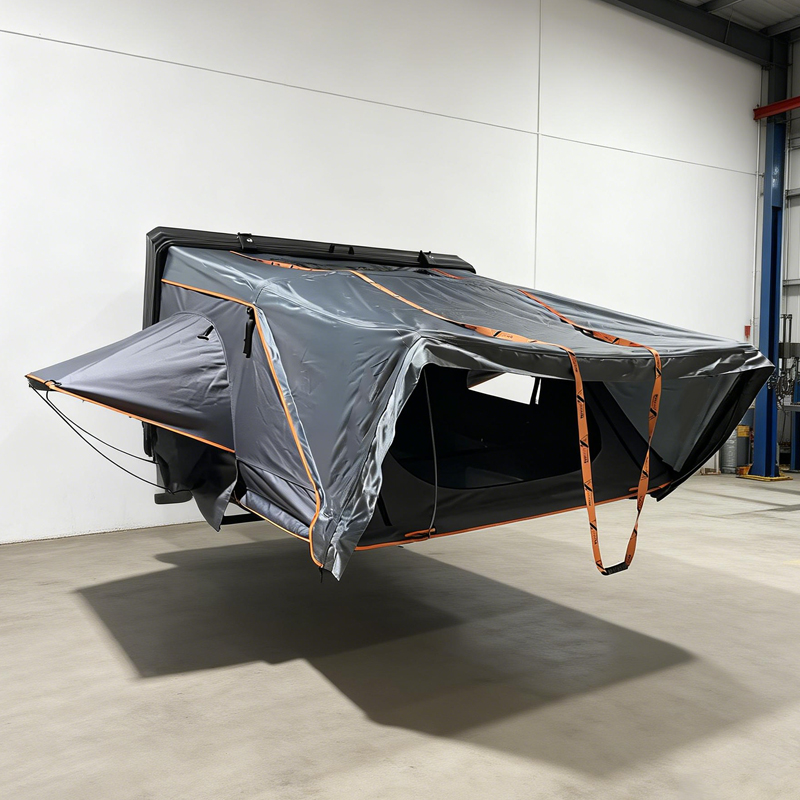
In contrast, a soft shell rooftop tent operates on a Side-Open mechanism, flipping sideways to expand and doubling its footprint. While they represent a bulkier transit option, the primary reason to select a soft top centers around actual spatial and occupancy needs. As they fold in half, the regular foam mattress, internal aluminum pipes, and polyester or oxford fabric walls stack upon one another, frequently exceeding 14 inches in packed height. However, these models provide ample space and usually offer a capacity for 2 to 4 people. They perfectly accommodate family scenarios, typically fitting 2 adults and 1 child, or up to 2 adults and 2 children. The main body of a soft shell takes about 3 to 5 minutes to open, aside from the time needed to set up the ladder, rainfly, and an optional annex room for rooftop tent.
For heavily modified off-road rigs operating at severe height disadvantages, a rugged low profile rooftop tent is mandatory. Constructed from extruded aluminum, these models maintain heights under 7 inches while offering exterior accessory channels. You can mount recovery gear without adding top-heavy bulk.
Consumers often base their clearance calculations solely on marketing brochures. Real-world installation reveals that advertised height is rarely the final number. Overlooking hardware nuances and dynamic movement leads to catastrophic roof damage.
The most frequent error is ignoring the mounting hardware gap. When a spec sheet claims a 6-inch thickness, it measures from the bottom baseplate to the top lid. It ignores the steel brackets required to attach it. Standard U-bolts protrude downward by at least an inch. While this might not increase the peak height of the vehicle, it drastically reduces the gap between the mounting rails and your car’s paint. If you use ultra-low crossbars, protruding bolts will shatter a panoramic sunroof during chassis flex.
Before any vehicle movement, always ensure your rooftop tent is properly closed and secured; however, you generally do not need to detach and remove the entire unit for short transit. When purchasing, it is also crucial to verify your rack's dynamic load (weight in motion), static load (weight when parked and occupied), and crossbar compatibility simultaneously. Whether or not you need to upgrade your original factory crossbars should be strictly determined by comparing these actual specifications.
Another critical mistake involves the bulge effect. Low-profile designs achieve sleek aesthetics by eliminating internal void space. If you add an aftermarket anti-condensation mat and leave a thick sleeping bag inside, the internal volume vanishes. Forcing the shell closed under extreme pressure warps the aluminum extrusions. It blows out the weather-sealing gaskets. This unpredictable bulge acts as an aerodynamic nightmare.
Finally, do not misjudge dynamic roof rack flex. Calculating static height in the driveway is only half the equation. When driving on corrugated dirt roads, the chassis experiences severe kinetic stress. A 150-pound rooftop tent subjects factory crossbars to massive G-forces, causing them to bow downward. Always leave a minimum of 1.5 inches of clearance between the bottom bolts and the vehicle roof to accommodate this structural flex.
Achieving the perfect overland build requires strategic installation. To maximize the aerodynamic benefits of a thin profile, you must optimize your mounting platform.
The foundation is the rack itself. Factory raised rails sit too high. To shave off crucial inches, upgrade to an extruded aluminum platform rack. These platforms sit incredibly close to the roofline and distribute weight evenly across the structural pillars. Installing directly onto a platform allows you to use sleek T-nut brackets. T-nuts slide directly into the aluminum channels, completely eliminating downward bolt protrusion.
Furthermore, you must address aerodynamic airflow. The gap between the vehicle roof and the bottom baseplate creates immense drag. Air rushes into this gap at 70 mph, hits the flat structural base, and creates a high-pressure parachute effect. Install a rigid wind fairing. By directing airflow smoothly over the top of the sleek shell, you utilize fluid dynamics to drastically improve acoustic comfort inside the cabin.
Lastly, respect weight distribution. Place the heaviest section of the unit directly above the vehicle's strongest load-bearing points, usually the B-pillars. Proper positioning maintains balanced handling and prevents excessive rack flex.
The thinnest models are premium aluminum wedge designs. By utilizing custom extrusions and a carefully fitted regular foam mattress, engineers have created shells that pack down to roughly 5.5 to 6.3 inches. This is achieved by removing all internal storage space and utilizing exterior gas struts that do not intrude on the mattress area.
Generally, no. The strict engineering tolerances required to achieve a 6-inch packed height leave virtually no void space. While a thin camping sheet might fit, thick supportive pillows and heavy winter sleeping bags must be stored in your trunk. Forcing the latches closed over thick bedding will permanently damage the hinges.
A thinner profile significantly preserves EV range compared to bulky models. Aerodynamic drag is the primary enemy of electric vehicles at highway speeds. Reducing the frontal surface area from 14 inches down to 6 inches allows air to flow smoothly, minimizing the turbulent wake. While you will still see a slight range drop due to the added weight, it is vastly superior to the 15 to 20 percent loss caused by traditional blocky setups.
No. A slim profile does not negate physical mass. While a thinner shell significantly reduces wind tearing force on your crossbars, the static and kinetic weight remains identical. An aluminum shell weighing 160 pounds still exerts 160 pounds of downward kinetic force over bumps. You must verify that your roof rack is rated for that specific dynamic load.
Absolutely not. Regardless of how thin or aerodynamic the shell is, automatic car washes use heavy spinning brushes and high-pressure jets that can catch on latches, rip off weather stripping, or damage the mounting hardware. Furthermore, the sheer weight of the rooftop tent combined with the force of the brushes can damage your vehicle's roof tracks. Always use touchless or hand-wash methods.
It depends entirely on your vehicle's base height and rack hardware. A standard residential garage door is 84 inches. If you drive a stock crossover measuring 66 inches tall, add a 2-inch crossbar, and a 6-inch wedge shell, your total is 74 inches. You will clear the door easily. However, if you drive a lifted 4x4 measuring 76 inches tall and add the same hardware, you hit 84 inches and will likely scrape. Always use the mathematical verification formula.
Verifying your packed height is a non-negotiable step before investing in an overland camping setup. Taking the time to properly measure your bare chassis, factor in rack height, and account for protruding mounting hardware will save you from devastating garage damage.
By understanding the distinct advantages of rigid aluminum structures and wedge designs, you can prioritize aerodynamics without sacrificing outdoor durability. Remember to account for dynamic flex, install wind fairings, and accept the necessary trade-offs regarding bedding storage. Stop guessing and start measuring. Evaluate your vehicle's specific load limits and clearance constraints, then explore the precision-engineered models at https://www.szmaitop.com to find the perfect aerodynamic match for your next off-grid adventure.