Views: 0 Author: Site Editor Publish Time: 2026-07-14 Origin: Site
Navigating immediate accessibility needs often clashes against strict property rules or space constraints. Installing a permanent structure is not always feasible. Renters face rigid lease restrictions. Historic homeowners encounter unforgiving building codes. Sometimes, you simply need a temporary fix for a visiting relative. This mobility dilemma pushes many families toward versatile alternatives. A temporary setup offers quick deployment and relative affordability.
However, a portable solution is never a universal fix. Buying the wrong size or type creates serious safety hazards for both users and caregivers. You must align your choice against specific spatial limits, caregiver strength, and vehicle requirements. You cannot simply guess the correct dimensions.
This article provides a straightforward framework for your decision. We will help you determine if a temporary unit meets your daily operational demands. You will learn how to measure inclines properly, evaluate surface materials, and mitigate daily deployment risks.
Best For: Rises of 30 inches or less, vehicle loading, temporary needs, and travel.
Not Recommended For: High elevations requiring ADA-compliant switchbacks, users with heavy power chairs lacking caregiver assistance on steep inclines.
Crucial Metric: Ramp length is dictated by the total rise; safety dictates a minimum 1:12 slope for unassisted use, though 2:12 is standard for assisted portable use.
Material Dominance: Aircraft-grade aluminum is the industry standard for balancing weight capacity with transportability.
Modular systems offer long-term stability. Installers bolt them directly into concrete pads or wooden decks. They include continuous, sturdy handrails. You rely on them to manage high-rise elevations effortlessly. They serve as reliable, weather-resistant permanent fixtures. Conversely, portable models fill an entirely different operational gap. You need them when flexibility matters most.
Historical homes often restrict exterior modifications. Rental properties rarely allow permanent alterations. Caregivers require quick deployments from their trunks. Navigating sudden doorway thresholds requires immediate adaptation. In these scenarios, portability proves highly effective. An accessibility ramp allows you to bypass structural barriers without altering the property itself.
Yet, physical limitations exist. You must understand the weight and force reality. A temporary unit might easily support 800 lbs of load. However, the physical weight of a longer unit presents its own challenges. An eight-foot metal structure weighs significantly. One caregiver cannot always lift or position it safely. You must balance the necessary weight capacity against the physical strength required for daily setup. A ramp loses its portability if the user cannot lift it.
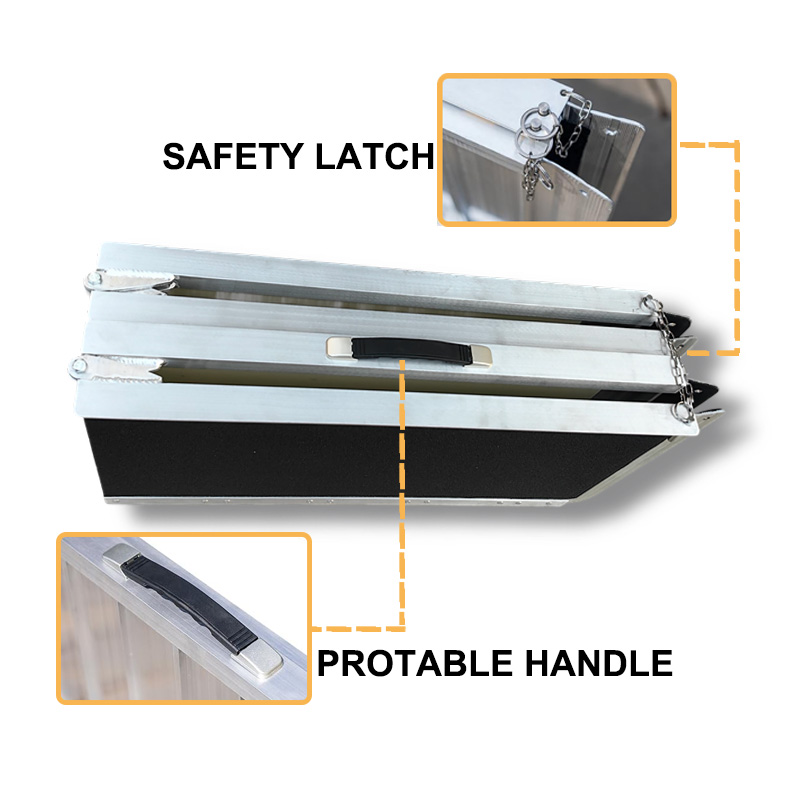
Suitcase ramps dominate the temporary access market. They fold down the center just like traditional luggage. You will find them highly effective for one to three steps. They also work exceptionally well for minivan side doors. A well-designed foldable mobility ramp splits the overall weight effectively. Multifold versions break down into two separate pieces. This mechanism drastically reduces caregiver strain. You must closely inspect hinge durability. Weak hinges bend permanently under heavy power chairs.
Threshold models serve a highly specific, limited use case. You place them directly at doorway transitions or sliding glass doors. They handle minor rises between one and six inches. Rubber options provide dense, quiet stability. They sit flush against the sill. Metal options offer lighter transportability but can scratch delicate hardwood floors.
Roll-up or track designs provide unique trade-offs. They roll into highly compact bundles. You can store them in narrow vehicle spaces easily. However, track systems require precise wheel alignment. They lack a continuous driving surface. Users often feel less secure navigating dual tracks. If the wheelchair swerves slightly, a wheel could drop off.
Material selection dictates longevity and usability. You should almost exclusively look for an aluminum ramp. Aircraft-grade aluminum delivers an unmatched load-to-weight ratio. It resists corrosion entirely. Wood rots and splinters over time. Fiberglass chips and cracks under stress. Aluminum never warps under seasonal temperature changes.
Ramp Type | Best Use Case | Maximum Ideal Rise | Portability Level |
|---|---|---|---|
Suitcase (Singlefold) | Curbs, single steps, minivans | 1 to 3 steps (approx. 15-20 inches) | High (folds like luggage) |
Multifold | Multiple stairs, higher vehicle loading | Up to 30 inches | Medium (separates into two pieces) |
Threshold | Doorways, sliding glass doors | 1 to 6 inches | Very High (lightweight, small) |
Roll-Up / Track | Travel, ultra-compact storage | Variable | High (requires precise alignment) |
Calculations determine user safety. Guessing the incline leads to dangerous deployments. The universal formula compares vertical rise against horizontal run. Independent use requires a strict 1:12 ADA slope ratio. For every one inch of vertical rise, you need twelve inches of ramp length. A three-inch porch requires a 36-inch run. Assisted temporary use permits a 2:12 ratio. This steeper angle strictly requires an able-bodied caregiver pushing from behind.
You must differentiate between static weight capacity and active load. Manufacturers often advertise 600 to 800 lbs limits. This represents static weight resting motionless. Your active load includes a heavy power chair, the user, and the caregiver moving dynamically. The combined dynamic force shifts heavily during transit. Always maintain a 20% safety buffer below the maximum listed capacity.
Surface traction requires careful consideration. Many budget models use applied grit tape. It provides excellent initial grip. However, grit tape peels and wears out continuously over time. Extruded or punched holes offer permanent grip. They shed water and snow instantly. Be aware they feel rougher on bare feet or sensitive pet paws.
Internal width ensures safe passage. Look for a minimum internal width of 30 inches. Your wheels need adequate room to pivot slightly. Edge protection remains non-negotiable. Extruded side rails or raised curbs prevent wheels from slipping off the edge.
Measuring the diagonal slope instead of the straight vertical rise.
Ignoring the ground clearance of low-profile mobility scooters.
Assuming a heavy-duty capacity rating makes the unit safe for steep inclines.
Deploying a long singlefold unit without a caregiver present.
SUVs and minivans present specific geometric challenges. Tailgates sit higher than side passenger doors. Bumper clearance often interferes with the top transition lip. You must measure the exact loading angle carefully. Too steep of an angle tips the wheelchair backward. Some vehicles require extended transition plates to clear bulky rear bumpers.
Independent travel brings unique logistical hurdles. Flying or road-tripping with a wheelchair ramp portable requires careful preparation. You must check TSA guidelines before arriving at the airport. Baggage dimensions vary wildly by airline. Always utilize a heavy-duty canvas storage bag. Exposed metal hinges easily catch and break during rough transit handling. Gate-checking your equipment prevents damage.
The "unanchored" risk represents the primary safety hazard. Temporary setups can slide backward violently during use. Wheelchair drive wheels push forward, forcing the metal structure backward. You must anchor the top lip securely. Mandatory mitigation involves proper hardware. Use steel security pins or clevis pins through pre-drilled holes. Top-lip transition plates also grip the landing step securely. Never deploy a temporary model on wet surfaces without engaging the anchor pins first.
Choosing the correct equipment requires a methodical approach. Follow these steps to ensure safe operation.
Step 1: Measure the Total Rise. Measure straight down from the highest landing point directly to the ground. Use a rigid tape measure and a level tool. Never estimate this number. Guessing leads to dangerously steep inclines.
Step 2: Assess Caregiver Capability. Consider who will move the unit daily. A 10-foot singlefold model weighs significantly. If a caregiver cannot lift 40-50 lbs safely, adapt your strategy. You must split a longer portable ramp into two modular pieces. Otherwise, abandon the portable idea entirely.
Step 3: Verify the Mobility Device Specs. Cross-reference your wheelchair or scooter measurements. Check the exact wheelbase width. Measure the ground clearance under the battery box. Low-clearance, three-wheel scooters easily high-center on steep crown hinges.
Step 4: Check Compliance and Certifications. Look past generic marketing claims. Seek out strict occupational safety testing. OSHA acknowledgments or ADA guideline compliance indicate a higher manufacturing standard. High-quality welds and reinforced hinges define a trustworthy product.
A portable access system serves as a highly effective mobility tool. It provides immense practical value when applied to appropriate rises. Correct slope calculations guarantee safe daily operations for everyone involved. You gain immediate access without permanently altering a building structure.
You must respect the physical limits of the equipment. Matching the material, width, and weight capacity to your exact chair prevents severe accidents. Aluminum remains the dominant material choice for reliable deployment.
Your next action is simple. Grab a measuring tape right now. Measure the exact vertical rise of your primary obstacle immediately. Calculate the required run length before you ever click on a specific product listing.
A: You will typically find 10 to 12 feet as the maximum length. Beyond this length, the metal becomes too heavy for a single person to lift. It loses its functional portability. Rises requiring more than 12 feet of run demand a permanent modular system equipped with resting platforms.
A: Yes, aircraft-grade aluminum resists rust and weather degradation completely. However, leaving it outside poses distinct risks. Snow and ice easily build up inside the traction grooves. You must also consider theft. Temporary models lack permanent concrete anchors, making them easy targets in unsecured front yards.
A: Medicare Part B rarely covers them. Standard policies classify these items as environmental modifications rather than durable medical equipment (DME). However, you might find coverage through specific state Medicaid waivers. Veterans can often secure full funding through specialized VA housing grants.
A: Industry standards generally range between 600 and 800 lbs. You must carefully calculate the active dynamic load. Add the total combined weight of the power chair, the user, any medical equipment, and the assisting caregiver. Always leave a generous safety margin below the absolute maximum limit.