Views: 0 Author: Site Editor Publish Time: 2026-08-17 Origin: Site
Portable seating often hides a high failure rate when exposed to harsh outdoor environments. Repeated deployment, uneven terrain, and dynamic weight loads systematically compromise structural integrity over time. You invest in gear expecting it to perform, but collapsed locking mechanisms, joint fatigue, and fabric tearing quickly turn a functional seat into dead weight on the trail. Carrying a chair in an efficient pack remains debated among ultralight travelers. However, proper ergonomic recovery after high-exertion activities like bikepacking justifies the weight penalty if you select the right frame. Resting off the cold, damp ground accelerates muscle recovery and reduces spinal compression. The challenge is identifying a frame that survives trail abuse. Mechanical cycle testing and lock mechanism evaluation provide the definitive framework for selecting reliable seating, moving far beyond basic weight and aesthetic metrics.
When evaluating an Outdoor Chair, you have to define mechanical failure accurately. Catastrophic failures, like a main support hinge snapping under a 200-pound load, are obvious and immediately end the product's lifespan. But progressive failures happen more often and ruin trips just as easily. Lock jamming prevents you from deploying or stowing the frame. Fabric sagging creates the "taco effect," where the seat collapses inward. This forces your hips and shoulders into a pinched posture, completely defeating the ergonomic purpose of the seat.
Let's look at the primary progressive failure points we see in the field:
Mechanical cycle lifespan is the core metric for durability. Testing facilities use automated pneumatic rigs to simulate years of abuse. They fold and unfold the frame thousands of times. They engage and disengage locks. They apply targeted pressure to hubs. Cycle testing pinpoints the exact moment of degradation. It tells engineers exactly when a specific alloy will bend or when a polymer hub will crack under repeated stress.
We also have to separate static load from dynamic load. A frame might hold 300 pounds of dead weight in a lab. Real-world application is entirely different. Human weight shifts constantly. You reach for a water bottle, lean forward to adjust a camp stove, or shift your posture on uneven gravel. This introduces lateral forces and sudden shock loads. Dynamic load testing evaluates how the frame geometry disperses these unpredictable forces without buckling the legs.
Uneven ground severely affects load distribution. When one leg sinks into soft mud or sand, the opposite leg takes disproportionate shear stress. This is where rigorous cycle testing proves its worth. A frame that survives 10,000 cycles on a flat lab floor might fail at 2,000 cycles if the testing rig simulates a 15-degree incline. Manufacturers that test for off-axis loading produce significantly more reliable gear for backcountry use.
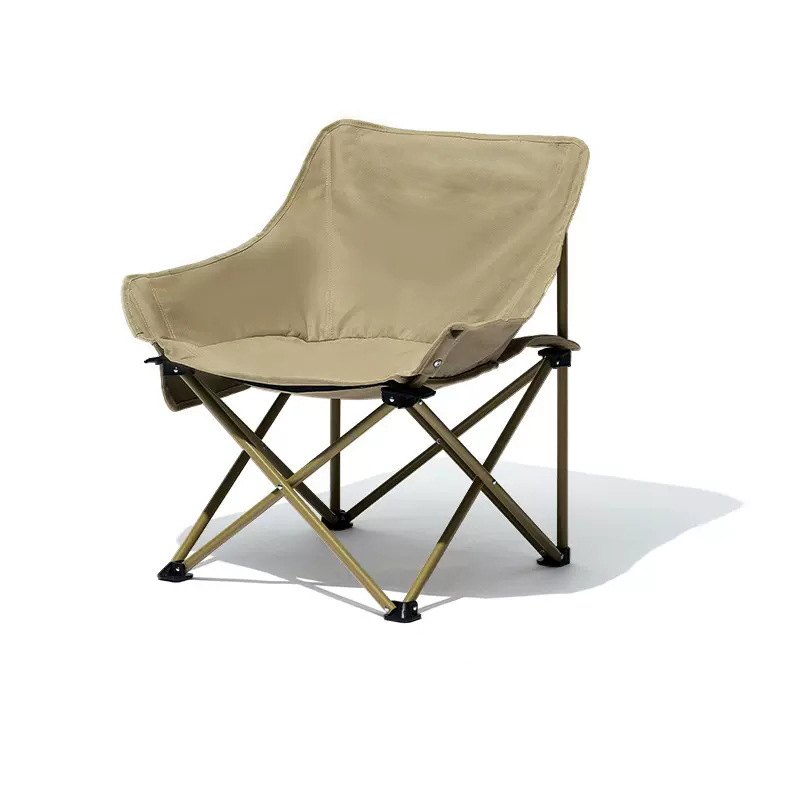
The architecture of a folding camping chair relies on its locking mechanism to maintain structural integrity. Dual-lock architectures are the standard for premium designs. These systems lock the frame open, pulling the fabric taut to create a firm foundation that resists sagging. They also lock closed. This secures the legs during transit, stopping the frame from snagging on brush or deploying accidentally while strapped to the outside of a pack.
Different locking mechanisms offer distinct advantages and vulnerabilities. Friction-fit systems use a central hub with inserted poles. They dominate the ultralight market because they are simple and lightweight. But repeated insertion wears down the pole ends and widens the hub sockets. Mechanical locks, like push-button or snap-lock mechanisms, provide positive physical engagement. They are highly secure but rely on internal springs that suffer from metal fatigue or fail if packed with dirt.
| Lock Type | Mechanism | Primary Advantage | Common Field Failure |
|---|---|---|---|
| Friction-Fit Hub | Poles slide into tight polymer sockets | Extremely lightweight, fast setup | Socket widening over time, causing pole wobble |
| Push-Button Lock | Spring-loaded metal pin engages a hole | Positive physical lock, high security | Spring seizes due to sand or rust infiltration |
| Snap-Lock Hinge | Tensioned lever clamps over a joint | High structural rigidity, easy to operate | Lever snaps under extreme cold temperatures |
| Twist-Lock Telescopic | Internal cam expands against tube wall | Infinite adjustability for leg height | Cam strips out, causing leg to collapse under weight |
Locking mechanisms dictate tension-based structural integrity. The fabric sling acts as a structural truss. When the lock engages, it stretches the fabric to a specific tension. This pulls the frame inward, locking the assembly into a rigid state. If the lock slips or the fabric stretches permanently, the frame loses rigidity. You get a wobbly seat that accelerates joint wear and eventually leads to a bent pole.
Stowed dimension metrics directly impact portability. Chairs that lock closed collapse into highly compact profiles. Some fold into a tight 6-inch cylindrical storage bag. Traditional flat-fold designs deploy faster but consume massive surface area, making them hard to pack in a bicycle pannier or a tightly loaded car trunk. Field evaluation must also account for environmental conditions. You need to assess how easily you can engage locks while wearing thick gloves. Push-buttons that are too small become severe liabilities in freezing temperatures when manual dexterity drops.
Frame material dictates lifespan and weight capacity. An aluminum folding camping chair typically uses aerospace-grade alloys like 7075-T6. This alloy offers an exceptional strength-to-weight ratio. It resists bending under cyclical stress and flexes just enough to absorb dynamic shock loads without snapping. Lower-grade aluminum or thin-walled steel tubes suffer permanent deformation after repeated heavy use, leaving you with a lopsided frame that cannot be repaired in the field.
Advanced frame architectures include 360-degree swivel mechanisms. Swivel chairs offer maximum comfort, letting you reach gear or tend a fire without standing up. But this convenience introduces a massive mechanical vulnerability. The central rotating hub houses bearings that take the entire dynamic load. Cycle testing shows these bearings are highly susceptible to failure from lateral torque and grit infiltration. Once sand gets into a bearing race, it grinds the metal down, causing the chair to seize or wobble violently.
Ultralight designs rely on plastic or polymer hubs to connect metal poles. These hubs are primary failure points. Extreme temperature variations destroy polymer strength. In sub-zero conditions, plastics become brittle and shatter under impact. In extreme heat, they soften, allowing metal poles to warp the socket shape. High-quality designs use reinforced nylon or glass-filled polymers to mitigate this, but UV degradation from sunlight will eventually break down the molecular bonds of any plastic left outside continuously.
Fabric and stitching endurance matter just as much as the metal frame. A high back canvas camping chair handles seam stress exceptionally well. Heavy cotton canvas or thick 600D Oxford cloth resists abrasion and campfire sparks. Ultralight chairs use ripstop nylon or mesh to shed ounces. These thinner materials rely on reinforced bar-tack stitching at the pole pockets. Cycle testing proves failure usually occurs where the stitching pulls through the material after thousands of micro-shifts, not in the fabric itself. Double-stitched flat felled seams offer much higher tear resistance than standard overlock stitching.
Selecting the right frame architecture requires strict alignment with your use case. Cycle touring and bikepacking demands are unforgiving. Cyclists face strict limitations on stowed dimensions and weight. Every ounce affects handling and climbing efficiency. Despite this, packing a mini camp chair provides essential physical recovery. Getting off the ground supports the lumbar spine and lets leg muscles rest properly after long hours in the saddle.
Optimizing for efficient packs makes a compact aluminum camping chair mandatory. The frame must break down into short, shock-corded sections that fit inside standard panniers or frame bags. Maintaining the bike's center of gravity is non-negotiable. A standard rear pannier has a specific taper. A chair packed down to 14x4 inches fits vertically alongside a sleeping pad. If it is 18 inches long, it forces the pannier lid open, exposing your gear to rain and throwing off your balance on technical descents.
Basecamp and car camping present different requirements. When a vehicle transports the gear, weight and packed size are secondary. You demand maximum comfort, durability, and stability. Heavy-duty, dual-locking steel frames or thick-gauge aluminum structures dominate here. These chairs sit higher off the ground, feature rigid armrests, and withstand high winds and heavy dynamic loads. They do not sink into soft ground as easily because their footprint is wider and their legs often feature broad, flat feet.
Understanding the trade-offs between packability and structural rigidity guides your purchase. There is an inverse relationship. High packability requires multiple folding joints and shock-corded hubs. Every joint is a potential failure point that reduces overall rigidity. Maximum structural stability requires fewer joints, continuous metal tubing, and locking hinges. You cannot achieve maximum packability and maximum rigidity in the same frame. You have to choose the compromise that fits your transport method.
Deploying mechanical folding chairs in wild environments exposes them to severe contamination risks. Sand, mud, and fine grit inevitably infiltrate locking mechanisms, swivel bearings, and shock-cord channels. When sand enters a push-button lock, it jams the spring. When mud dries inside a friction-fit hub, it acts like sandpaper, accelerating abrasion on the aluminum poles. Saltwater exposure accelerates oxidation on aluminum and rusts any steel components, including internal springs and hinge pins.
Mitigating these risks requires strict maintenance. Field gear is not maintenance-free. You must establish protocols for cleaning and lubricating mechanical locks to ensure they function on the next trip.
Follow these field maintenance protocols:
Evaluating warranty and replacement availability provides a final safety net. High-quality manufacturers know that even cycle-tested gear breaks under extreme use. Look for brands offering modular replacement parts. Buying a replacement polymer hub, a single aluminum leg, or a new fabric sling extends the life of the chair indefinitely. Avoid brands requiring full-unit replacement for a single broken component, as this indicates a disposable design philosophy that will cost you more in the long run.
Take the following actions to finalize your seating selection and ensure long-term field reliability:
A: It is a mechanical system that secures the chair in the open position to maintain structural stability and keep the fabric taut. It also locks the frame closed for secure transport. This prevents accidental collapse under shifting weight and stops the legs from deploying while strapped to a pack.
A: Manufacturers use automated pneumatic rigs to simulate years of field use by mechanically folding and unfolding the chair thousands of times. This process applies repeated stress to identify weak points in hinges, measure elasticity loss in shock cords, and track friction wear inside polymer hubs.
A: The ideal chair for bikepacking features a shock-corded aerospace-grade aluminum frame, weighs under two pounds, and collapses into a cylinder smaller than 14 inches. This specific geometry allows it to fit seamlessly into panniers or frame bags without disrupting the bicycle's center of gravity.
A: While they offer excellent range of motion, the central rotating hub introduces a significant mechanical vulnerability. The bearings are highly susceptible to grit and sand infiltration. They require strict cycle testing and frequent field cleaning to prevent friction-induced failure under dynamic human weight.
A: Aluminum does not rust because it contains no iron. However, it can corrode or oxidize, developing a powdery white coating if exposed to salt water, road salt, or harsh chemicals. You must clean and dry the frame thoroughly after field use to prevent this degradation.
A: Sagging is caused by the fabric stretching over time due to dynamic loading, seam fatigue at the anchor points, or a failure in the frame's locking mechanism to maintain proper outward tension. Once the fabric loses its structural tautness, ergonomic support degrades rapidly.
A: Yes, despite the weight penalty, many cyclists find it essential. The ergonomic back support and off-the-ground recovery provided by a compact chair significantly improve multi-day touring endurance. It relieves spinal compression and allows leg muscles to rest properly after high exertion.