Views: 0 Author: Site Editor Publish Time: 2026-07-16 Origin: Site
Navigating steps, raised landings, or vehicles can turn routine outings into stressful, physically demanding challenges. For wheelchair and scooter users, these everyday obstacles block independence. A single step often feels like a massive wall. While permanent modifications offer long-term solutions, they require significant effort. You must secure building permits. You have to hire contractors. You also face high upfront construction costs. Families often wait weeks for wood or concrete structures to finish.
Fortunately, a portable ramp offers immediate, adaptable relief. It bridges gaps quickly. However, you must select it carefully. Strict attention to safety limits prevents accidents. Weight capacities and slope requirements demand careful evaluation. A temporary setup works beautifully, but only if you follow essential safety physics. This guide breaks down how you evaluate and choose the right temporary solution without compromising security.
Portable ramps bridge the gap between permanent home modifications and immediate accessibility needs without requiring building permits.
Selecting the correct slope ratio (aiming for ADA recommendations even at home) is the single most critical factor in preventing falls and equipment tipping.
Material matters: A mobility ramp aluminum construction offers the best strength-to-weight ratio for daily transport.
Different environments (vehicles vs. front steps) dictate whether a single-fold, multi-fold, or threshold design is required.
Everyday obstacles increase risks for everyone involved. Single steps, raised thresholds, and curbs limit user independence heavily. These barriers also put extreme physical strain on caregivers. Attempting to lift a heavy wheelchair over a small step frequently causes severe back injuries. Caregivers lose their balance. Equipment tips backward easily. A simple trip to the grocery store quickly turns into a hazardous physical hurdle. You cannot ignore these daily friction points.
Statistically, un-ramped steps present a massive fall risk. Caregivers often underestimate the sheer weight of a powered mobility device. An average power chair weighs over two hundred pounds empty. Add the weight of the user, and manual lifting becomes physically impossible. Utilizing a stable, slip-resistant surface changes everything. It creates a smooth transition plane. It gives caregivers complete, safe control over the wheelchair descent. The safety profile improves instantly.
Permanent modifications often stall due to bureaucracy. Concrete ramps take weeks to pour and cure. Wooden ramps require extensive homeowner association (HOA) approvals. They also face weather delays and contractor scheduling conflicts. A portable access ramp completely bypasses HOA approvals. You avoid contractor delays. You simply unfold the equipment and use it immediately. It serves as an excellent immediate stopgap. For many families, it transitions into a highly flexible, long-term solution.
Different environments require different engineering approaches. You cannot use one single design for every mobility challenge. Mapping specific user needs to the right equipment category ensures safety. We break down the primary categories below. You must match your environmental barrier to the correct structural design.
Manufacturers design these specifically for minor height differences. They tackle 1-to-3-inch doorframes effectively. They also bridge sliding glass door tracks beautifully. Often, manufacturers use heavy-duty rubber or lightweight aluminum for these models. You can leave them in place permanently. Because they lack complex hinges, they sit flush against the door lip. You can also easily move them between interior rooms as needed.
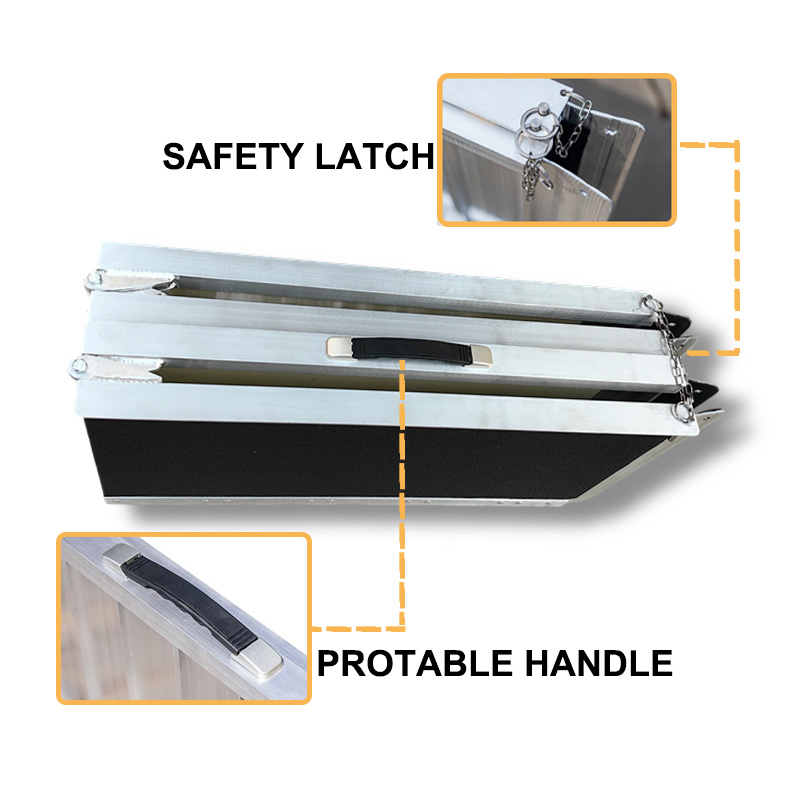
These units work best for short distances. They handle one to two steps easily. They also bridge the gap into low minivans perfectly. Engineers hinge them directly down the middle. This creates a highly convenient "suitcase" style carrying method. A foldable wheelchair ramp usually features an integrated carrying handle. Caregivers fold it, grab the handle, and place it in the car trunk within seconds.
You need this category for higher rises. Porches, elevated decks, and standard SUVs require longer inclines. A longer run means a heavier piece of metal. To solve this, multi-fold designs split into separate, manageable pieces. They fold both lengthwise and widthwise. This manages the physical weight of the longer material. It ensures a single caregiver can still transport the system safely.
Ramp Category | Ideal Rise Range | Primary Use Case | Portability Level |
|---|---|---|---|
Threshold | 1 to 3 inches | Doorframes, sliding glass doors | High (often kept in place) |
Single-Fold | 2 to 5 inches | Single steps, low curbs | High (suitcase folding design) |
Multi-Fold | 6 to 14+ inches | Porches, deck stairs, standard vehicles | Medium (requires segmenting pieces) |
You must separate high-quality medical equipment from cheap alternatives. Substandard materials bend under pressure. They lack adequate traction. You evaluate safety dimensions strictly to protect the user. We look at material integrity, surface grip, and physical limitations to determine reliable performance.
The industry heavily favors specific structural materials. A mobility ramp aluminum build sets the industry standard for several distinct reasons. Aluminum provides aggressive rust resistance. It survives harsh rain, snow, and ice without degrading. Furthermore, extruded aluminum delivers massive weight capacity while remaining relatively light. It maintains strict structural integrity under repeated heavy loads. Wood rots over time. Steel rusts and weighs too much. Aluminum solves both problems efficiently.
Surface traction determines wet-weather safety completely. Manufacturers generally offer two main traction surfaces. First, they use applied grit-coat tape. This resembles heavy sandpaper. It grips rubber tires well, but it can peel away after years of heavy sun exposure. Second, they use punched-extruded surfaces. Machines punch small holes through the aluminum from the bottom up. This creates raised, jagged edges. Punched surfaces offer permanent, superior traction. They also allow rain and snow to drain straight through the metal.
A temporary access unit is never a universal fix. You must acknowledge its physical limitations. Caregivers often make the dangerous mistake of "steep sloping." This happens when you use a short run for a very high drop. Steep sloping shifts the center of gravity backward. It creates a terrifying tipping hazard for the wheelchair user. It also makes pushing the chair physically impossible for the caregiver. Always prioritize safety over convenience. If the slope feels too steep, it is definitively unsafe.
How do you deploy the equipment safely in real-world conditions? Practical application requires specific techniques. You encounter different geometric challenges at home versus on the road. Caregivers need a clear understanding of deployment mechanics.
Deploying over vehicles requires precise measurements. You must measure the deck height of your specific van or SUV. Side-entry minivans usually feature lower deck heights. Rear-entry vans sit higher off the ground. You must ensure the lip transition plate rests securely on the vehicle bumper. The transition plate must sit completely flat. Any gap creates a trip hazard. Quality models include rubberized grips underneath the lip. These grips grab the bumper firmly and prevent dangerous shifting.
Deploying a home accessibility ramp over porch stairs demands rigid stability. You lay the unit over the steps. Next, you must secure the top lip directly to the wooden or concrete landing. Most manufacturers drill small holes in the upper transition lip. They supply steel clevis pins. You drill matching holes into your porch landing. You drop the clevis pins through the metal lip and into the porch. This permanently stops the metal from sliding backward away from the landing during use.
Travel readiness involves managing harsh physical realities. We must discuss physical weight honestly. A 10-foot multi-fold model often supports up to 800 lbs of rolling weight. However, the aluminum structure itself weighs over 50 lbs. An elderly caregiver cannot safely lift 50 lbs out of a car trunk. Multi-fold designs allow you to pull a center pin. This separates the unit into two 25 lb sections. You must manage this physical reality before traveling. Always ensure the primary caregiver can lift the segmented pieces comfortably.
You need a precise decision framework to purchase the right equipment. Guessing the size leads to dangerous outcomes. Follow this step-by-step sizing and purchasing criteria. It guarantees a safe, functional deployment every single time.
Selecting the proper length dictates the final slope. A steep slope causes accidents. A gentle slope requires longer materials.
Commercial standard: The Americans with Disabilities Act (ADA) recommends a 1:12 ratio for unassisted, public access. This means you need 1 foot of ramp length for every 1 inch of vertical rise. If your porch is 12 inches high, you need a 12-foot length.
Residential/Occupied standard: A 2:12 ratio is acceptable for temporary residential use. You need 1 foot of length for every 2 inches of rise. You only use this steeper standard if a strong, able-bodied caregiver pushes the occupied chair. If the user drives a heavy power chair independently, stick closer to the 1:12 commercial ratio.
You must calculate the total combined moving weight accurately. Never estimate this number blindly. You add the weight of the user first. Next, you add the weight of the wheelchair or heavy power scooter. Finally, you add the weight of the caregiver pushing it. A heavy power scooter alone often hits 250 lbs. Total moving weights easily exceed 500 lbs. Always look for equipment offering minimum 600-to-800 lb ratings. Extra capacity ensures the metal frame never flexes or bows under pressure.
Length directly impacts how you carry the equipment. Short units travel easily. Long units become bulky and difficult to maneuver. If your required length exceeds 8 feet, you must change your approach. You must transition away from a basic suitcase model. Instead, select a modular or multi-fold system. These split into lighter, separate components. This logic manages deployment weight. It protects caregivers from lifting injuries. It keeps the setup process completely manageable.
A portable ramp completely removes immediate friction from daily life. It bridges door thresholds safely. It conquers front porch stairs reliably. It grants fast access to vehicles. You bypass massive construction delays entirely. You just need to select the correct size and follow strict safety guidelines.
Take immediate action before browsing product catalogs. Grab a measuring tape. Measure your specific "total rise." This is the vertical height from the ground directly to the top landing. Write this measurement down carefully. Use the ADA rule of thumb to calculate your required length. Evaluate your combined weight requirements honestly. Finally, if your total rise exceeds 24 inches, consider pausing your search. We highly recommend consulting a mobility specialist for heights over 2 feet, as longer runs require complex modular platforms.
A: Yes, if it is made of non-corrosive aluminum with proper drainage holes and high-traction grit. Extruded aluminum resists rust completely. However, routine clearing of wet leaves, snow, and debris is required to maintain a safe, slip-resistant walking surface.
A: Portable ramps are not strictly regulated by the ADA for private residential use. The ADA governs public and commercial spaces. However, reputable manufacturers design them to meet ADA slope, weight, and traction safety standards to ensure maximum user protection.
A: Weight varies by length and design. A 3-foot aluminum suitcase model may weigh only 15 lbs. An 8-foot multi-fold model can weigh 50-60 lbs. Always check the specific item weight to ensure the caregiver has no lifting limitations.
A: Quality models feature rubberized transition plates. They also include protective pads at the top and bottom metal edges. These rubberized surfaces prevent gouging on hardwood floors and protect vehicle bumpers from sliding and scratching.